 AI can now reproduce a person’s face, voice, movement, and likeness with increasing realism.
The bigger question is becoming: Who gets to control that identity, authorize its use, and potentially get paid when it has commercial value?
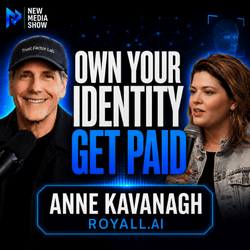
In Episode #684 of the New Media Show, Host Rob Greenlee talks with Anne Kavanagh, co-founder of Royall.ai, about building a new permission and licensing layer around human identity.
The conversation is not about stopping or being anti-AI. It is about establishing something that has largely been missing: proof and authorization before use.
Your Identity Becomes an Asset You Control
Royall.ai is developing what Anne describes as a biometric vault where people can register elements of their identity, including voice, face, likeness, and body motion.
Those assets can be fingerprinted and watermarked, creating the foundation for detecting use, approving or rejecting it, and potentially licensing it commercially.
That changes the discussion from simply asking whether AI can clone someone to asking whether the person actually gave permission.
A creator could potentially say:
- Use my voice for this campaign, but only for six months.
- Allow my likeness to be used to train this model, but pay me.
- Do not use my identity for this purpose at all.
- The central principle is simple: You own you.
Protection and Opportunity
The same technology designed to identify unauthorized use could also create legitimate new markets for human identity.
Anne describes a future where AI companies, studios, agencies, platforms, and brands could license verified human data rather than simply collecting material from the public internet.
Creators could choose whether their voice, face, movement, or content can be used for AI training and receive compensation when they opt in.
This becomes especially important as synthetic media becomes indistinguishable from human media. Rob also raises another possibility: as AI-generated content becomes abundant, verified or certified human-created content may itself become more valuable.
Podcast Archives Create Another Rights Problem
The discussion gets particularly relevant to podcasting. A podcast owner may control thousands of hours of archived conversations, but that does not necessarily mean the owner has the right to license every guest’s voice for AI training.
Rob explains that the New Media Show archive has previously attracted interest for conversational AI training, but licensing complete conversations would require permission from the guests whose voices appear in them.
Royall.ai is exploring infrastructure that could help identify those participants, request consent, manage permissions, and create licensing transactions across large content libraries.
That could become a significant issue as decades of podcast, video, music, and creator archives become valuable training material.
Discussion Highlights
– Who should control your voice, face, and digital likeness
– Creating a biometric identity vault
– Consent before AI use
– Detecting unauthorized likeness and voice usage
– Licensing human identity for AI training
– Getting creators paid for authorized use
– Deepfakes, scams, and identity theft
– Why trust is critical to biometric infrastructure
– AI disclosure versus AI-assisted creation
– The rise of verified human-created media
– Creator contracts and synthetic likeness rights
– Licensing podcast archives for AI training
– Why guest consent matters
– Royall.ai as an identity and permission API layer
Chapter Timestamp Markers
00:00 Who controls your likeness and voice identity?
03:00 Introducing Anne Kavanagh and Royall.ai
07:00 How the idea behind Royall.ai developed
09:00 Verified identity, authorization and licensing
10:00 Creating a biometric vault for voice, face and motion
18:00 Detection, reporting and takedown tools
20:00 Opting into AI training and getting paid
24:00 Building a training-grade voice model
28:00 Identity protection becomes an economic opportunity
34:00 Why this is a human issue, not just a creator issue
38:00 Deepfakes, students, scams and identity theft
40:00 The trust challenge of storing biometric identity
43:00 Building a registrar for human identity and likeness
45:00 Royall.ai as part of the technology stack
48:00 The principle: You own you
53:00 AI tools, disclosure and audience trust
59:00 Could certified human content become premium?
01:02:00 Synthetic podcast hosts and transparency
01:04:00 Creator contracts and consent for AI training
01:05:00 Licensing podcast archives and guest voices
01:08:00 Who controls your existing content libraries?
01:11:00 How Royall.ai early access works
01:14:00 Public images, copyright and identity ownership
Anne Kavanagh Guest Links
Royall.ai is currently onboarding users through an early-access process, with registration, fingerprinting, watermarking, detection capabilities, and enterprise/API integrations discussed toward the end of the episode.
Royall.ai
https://royall.ai
Host, Rob Greenlee and Show Links
New Media Show
https://newmediashow.com
New Media Show on YouTube
https://youtube.com/@TheNewMediaShow
Rob Greenlee
https://robgreenlee.com
Rob Greenlee on LinkedIn
https://www.linkedin.com/in/robgreenlee
Podcast Hall of Fame
https://podcasthall.com
AI Disclosure
AI tools helped organize and edit the episode to remove filler words; this description was created from the completed full transcript of episode #684. The recorded conversation, human performances, perspectives, editorial direction, and final responsibility for the episode remain with Rob Greenlee and Anne Kavanagh. The New Media Show is human-hosted.
Podcast: Play in new window | Download
Subscribe: Apple Podcasts | Android | Podcast Index | RSS
Podcast (audio): Play in new window | Download
Subscribe: Apple Podcasts | Spotify | Android | Podcast Index | RSS