The Human Signal: What Becomes Valuable in AI Creation Era | Jaymi Bauer #682

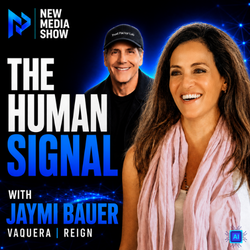
New Media Show with Podcast Hall of Famer Rob Greenlee and Guest   Jaymi Bauer. Jaymi is CEO and co-founder of Vaquera Group, creator of Resonance Design, and founder of a new women’s vitality venture called Reign.Care.When AI content becomes abundant, what becomes scarce?

In Episode #682 of the New Media Show, Host, Rob Greenlee talks with growth and brand strategist Jaymi Bauer. Jaymi is CEO and co-founder of Vaquera Group, creator of Resonance Design, and founder of a new women’s vitality venture called Reign.Care.

She and Rob previously worked together at Microsoft during the Zune and Xbox eras, giving both a long view of how technology continually reshapes media and human behavior.

The conversation is not anti-AI. It is about understanding where AI is powerful and where human creators may still have the advantage.

The Human Signal

Jaymi states that humans feel trust before they intellectually recognize it. We respond to tone, presence, energy, emotion, authenticity, and whether something feels genuine.  AI can increasingly reproduce human language, imagery, voices, and creative patterns, but Jaymi believes audiences will continue seeking something deeper: content rooted in real human experience.

Her advice to creators is simple: Become better at AI while becoming even more human. AI as Amplifier, Not the Source

Rob and Jaymi explore AI as a creative and production layer rather than the original source of meaning.

AI can:

Research faster
Organize ideas
Improve production
Expand visual possibilities
Help creators distribute content
Personalize discovery
Build new interactive experiences

But the strongest output still begins with a strong human seed: an idea, experience, perspective, story, or creative intention.

Jaymi shares her experience of heavily using AI on a book proposal. The result was polished, but she felt it had become hollow and disconnected from her own creative voice. That became a reminder that efficiency does not automatically create resonance.

Why Human Content May Become Premium

As synthetic media becomes harder to distinguish from human-created media, Rob raises the possibility that creators may eventually label content as human-hosted or human-created, rather than simply labeling AI content.

Jaymi believes genuine human interaction may eventually feel more valuable precisely because it becomes less common.

That could increase the value of:

Live conversations
Human-created storytelling
Live music and events
Real relationships
Distinctive personal perspectives
Physical experiences
Trusted communities

The future may not be human versus AI. It may be human creativity amplified by AI.

Creators Need AI Literacy

Jaymi strongly advises creators not to ignore AI. Her view is that creators should learn the tools, experiment with them, understand their limitations, and explore what they make possible. But they also need stronger critical thinking and editorial judgment.

Rob and Jaymi discuss how experienced professionals may have an advantage here because they have lived through multiple cycles in technology, media, business, and the economy.

Knowing when AI is wrong, when to stop refining, what matters, and what audiences actually value may become increasingly important skills.

AI Changes Discovery Too. AI is not only creating content. It is increasingly sitting between creators and audiences.

Rob discusses how platforms such as YouTube use AI to analyze media, understand content, personalize recommendations, and decide who should see what.

That means creators are entering an environment where AI may influence:

Creation
Editing
Distribution
Metadata
Search
Recommendations
Audience targeting
Personalization

The creator still provides the human idea, but AI increasingly shapes how that idea reaches the world.

A More Interactive Media Future

The conversation also explores AI-powered audience participation. Rob describes emerging platforms where synthetic personalities, expert knowledge bases, and human audience members can participate in shared conversations.

Instead of traditional one-way media, future shows could include creators, audiences, and AI agents discussing topics together.

That could make podcasts, livestreams, sports media, education, and communities considerably more interactive.

Discussion Highlights
-What Jaymi means by the “human signal”
-Why trust is often felt before it is understood
-AI-generated media versus human-created media
-Why creators should become “superhuman,” not anti-AI
-AI as a creative amplifier
-The importance of critical thinking and editorial judgment
-Why AI-generated work can feel polished but hollow
-How experienced professionals can work effectively with AI
-AI’s growing role in discovery and recommendation
-Personal LLMs and creator knowledge models
-Human and AI participants inside future media experiences
-Why live and human-created experiences could become premium
-The possibility of labeling media as human-hosted
-Creativity, trust, and relationships as long-term advantages

Chapter Markers

00:00 Why the human signal matters
01:32 Introducing Jaymi Bauer
02:48 What is the human signal?
05:35 Can AI reproduce human connection?
09:15 Staying human while using AI
11:22 Collective AI knowledge versus individual human knowledge
13:30 Why audiences may eventually reject synthetic sameness
16:04 Will AI-generated entertainment satisfy us?
18:35 AI as a new creative tool
21:05 Lessons from Xbox and immersive media
23:10 Why gamers still want human creativity
25:10 How humans remain valuable
26:38 The dystopian side of AI
28:10 Could AI eventually give humans more freedom?
30:05 Creativity as a human advantage
31:15 Why creators need AI literacy
33:15 Becoming “superhuman”
34:25 Jaymi’s AI-generated book proposal mistake
36:00 Using AI as a first draft
37:20 Better prompts start with better human thinking
38:25 When AI becomes inefficient
40:20 Humans as AI tutors and experts
42:15 What happens when AI gains real-world experience?
45:10 Human truth and durable brands
48:10 AI becomes the discovery layer
51:00 Personal LLMs and expert AI models
52:20 AI-powered audience participation
55:00 Humans and AI in the same conversation
57:10 AI companionship and relationships
59:55 Will human-created media become premium?
01:01:05 Hybrid human and AI production
01:03:10 Where to find Jaymi
01:04:00 Jaymi’s new vitality venture
01:05:40 Closing thoughts

Jaymi Bauer Guest Links:

Jaymi Bauer on Substack
https://jaymibauer1.substack.com

“The Human Signal”
https://jaymibauer1.substack.com/p/the-human-signal

Vaquera Group
https://vaquera.co

Reign
https://reign.care

About the Host:  Rob Greenlee is a 2017 Podcast Hall of Fame inductee, Chair of the Podcast Hall of Fame, founder of Trust Factor Lab, and longtime new-media executive, creator, strategist, and industry leader.

Through The New Media Show, Rob explores the changing intersection of podcasting, video, creator-led media, artificial intelligence, platforms, audience ownership, trust, monetization, and the future of human-created media.

Host and Show Links

New Media Show
https://newmediashow.com

New Media Show on YouTube
https://youtube.com/@TheNewMediaShow

Rob Greenlee
https://robgreenlee.com

Rob Greenlee on LinkedIn
https://www.linkedin.com/in/robgreenlee

Podcast Hall of Fame
https://podcasthall.com

AI Disclosure

AI tools were used to assist with organizing and editing to remove filler words; this episode description was created from the completed full transcript of episode #682. The recorded conversation, human performances, perspectives, editorial direction, and final responsibility for the episode remain with Rob Greenlee and Jaymi Bauer. The New Media Show is human-hosted.

Why “Fringe” Was the Wrong Word and What I Actually Meant About Podcasting 2.0

By Rob Greenlee
New Media Show with Rob Greenlee - NewMediaShow.comThis article provides context about my comments on New Media Show episode 660 with Libsyn CEO Brendan Monaghan, where we discussed Podcasting 2.0, RSS tag adoption, and the gap between innovation and mainstream platform implementation.
During my recent interview conversation with the Libsyn CEO, I used the word “fringe” when discussing Podcasting 2.0 RSS extension tag ideas. That comment in an extended audio clip was played and discussed on “Podnews Weekly Review“, and understandably, it raised concerns in parts of the podcasting 2.0 community, including Dave Jones and Adam Curry on the Podcasting 2.0 podcast.  Let me say this clearly. That was not the right word for me to use, and I regret saying it that way. Not because I am backing away from the broader point I was trying to make, but because the word itself does not reflect how I actually view the work happening in the Podcasting 2.0 and open RSS ecosystem.
The comment came out quickly in a live discussion and did not carry the full context I intended.
What I was trying to describe is something I have repeatedly seen said over the past two decades working with large platforms, hosting companies, and media organizations: there is a real difference between something that is not widely adopted yet and something that is not valuable.
Podcasting 2.0 Innovation Has Real Value
Podcasting 2.0 innovations are valuable. RSS namespace expansion, new tags, and experimentation around monetization, identity, transcripts, funding, and distribution all matter. This is where much of the real innovation in podcasting is happening.
At the same time, many of these capabilities have been around for several years, in some cases for close to five years. That historical context matters. My comment was not about the value of the ideas themselves. It was about the pace and pattern of adoption, especially among larger platforms.
When I used the word “fringe,” I was referring to the broader set of emerging and evolving tag ideas within the Podcasting 2.0 initiative.
There are many tags and concepts at different stages of maturity, market fit, timing, and implementation. Not all of them have broad agreement or adoption, even within standards-focused efforts like the Podcast Standards Project. From a product and platform perspective, this creates a spectrum of adoption rather than one unified standard that everyone has fully embraced.
What I Was Trying to Say
What I meant is that market fit and timing play a major role in what gets adopted at scale. Larger podcasting platforms tend to move more deliberately. Their decisions are shaped by user experience, engineering resources, monetization models, product stability, support complexity, and business priorities.
That often means only a subset of new capabilities gets integrated into mainstream products at any given time. That has been the pattern over the past several years. But it is also important to say this pattern is changing.
Momentum Started Very Slow, But Is Building
Over the past year or so, we have started to see real momentum around some Podcasting 2.0 tags and capabilities. More platforms are experimenting. More tools are supporting them. More creators are becoming aware of what is possible and how these features can be used in real workflows.
That has been great to see
I believe we will continue to see more adoption of certain RSS tags as platforms, tools, and creators find clearer ways to integrate them into everyday use.
Some Tags Are Seeing More Adoption
You can already see this progression in parts of the ecosystem.
Tags like transcript, chapters, and person have seen meaningful adoption because they provide immediate and understandable value. The Alternative Enclosure tag is being more widely adopted across platforms, too. They improve accessibility, discovery, context, and creator attribution.  The funding tag has gained traction within parts of the ecosystem, especially among creators and platforms exploring alternative monetization models. The value tag, which supports value-for-value and streaming payment models, has been adopted within specific apps and communities, though it has struggled more recently and has not yet become mainstream across larger platforms. Other tags and ideas are still at an earlier stage. Some are being tested. Some are evolving. Some are still looking for the right use case that will drive broader adoption. That is what I meant by a spectrum of innovation.
Innovation and Adoption Are Not the Same Thing
Podcasting operates across two layers simultaneously. 
There is an innovation layer, where developers, independent platforms, and forward-thinking creators create and test new ideas. Then there is a platform layer, where those ideas are evaluated, prioritized, supported, and integrated into products used by millions of people.  The gap between those two layers is where much of the tension comes from.
I have seen this pattern many times. Podcasting itself began outside the mainstream.
Mobile listening took time to become the default. Video podcasting has gone through multiple cycles before finding its current role. Programmatic advertising in audio took years to mature.  Innovation usually moves faster than adoption. Adoption follows when user demand, product fit, creator benefit, and business alignment come together.
That is where many Podcasting 2.0 capabilities have been.
My View of Podcasting 2.0 and the Podcast Standards Project
I also want to be clear that Podcasting 2.0 and the Podcast Standards Project are not the same thing. They overlap in some areas, but they do not necessarily embrace every tag or idea in the same way.
That is part of the larger point.
When standards-oriented efforts evaluate which capabilities to support, it shows that this is not simply a question of innovation versus resistance. It is about maturity, usefulness, interoperability, timing, and market fit.  That is the context I was trying to convey, though I did not do so well at the time.
I Respect the Podcasting 2.0 Community
So when I used the word “fringe,” I was trying to describe how some organizations have historically perceived ideas that had not yet reached scale or product integration. But I understand how that word sounded dismissive of Podcasting 2.0, and that is not how I really see it.

I respect and appreciate the innovation and work happening through PodcastIndex.org, Podcasting 2.0, and the broader open podcasting community, including the work and advocacy of Adam Curry, Dave Jones, Daniel J. Lewis, and many others.

The opportunity now is to build on the momentum emerging and move the most valuable ideas toward broader adoption. That means making these capabilities easier to use, improving listener experiences, aligning them with sustainable business models, and demonstrating clear value at scale. That is how innovation moves from experimentation into everyday use.
My Role in the Conversation
I do not want to frame this as one side versus another. I am focused on helping connect what is being built with what is actually being adopted and used at scale.
That is the conversation we are having every week on the “New Media Show“. Join us LIVE on Weds, 3 pm PST/6 pm EST, or on demand in all the podcast apps and live on YouTube.com/@robgreenlee, LinkedIn.com, Facebook.com, and X.com
So, yes, I regret the word “Fringe” I used.  But I stand by the broader point that there has been a gap between innovation and adoption in podcasting over the past several years. The good news is that momentum is building, and that gap is starting to close.  That is where the real opportunity is for all of us in this industry.

About the Author
Rob Greenlee is a 2017 Podcast Hall of Fame inductee and Chair, a global new media leader who bridges podcasting’s human roots with its AI-driven future. As founder of Trust Factor Lab and host of the “New Media Show” and “Spoken Human”, Rob helps creators start, grow, monetize, and future-proof their content. He’s held leadership roles at Microsoft, Spreaker, Libsyn, StreamYard, and PodcastOne, and serves as Chairperson of the Podcast Hall of Fame. Learn more at RobGreenlee.com and join the Trust Factor Lab Creator/Podcast Services.

Personal note: I used AI tools to help organize this article and hand-edited it; the views, clarifications, responsibility, and industry perspective are mine. I have been working in podcasting and platform adoption for more than two decades, and this article reflects my own position. The original word choice was mine, and so is the clarification.