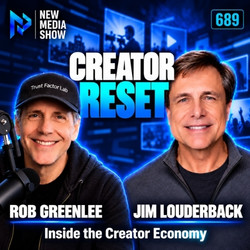
 In New Media Show #689, I’m joined by Jim Louderback, publisher of Inside the Creator Economy and former CEO of VidCon and Revision3, to explore what the next phase of the creator economy means for people building media businesses.
Jim and I have lived through several shifts at the intersection of media and technology. This conversation connects the early days of video podcasting with today’s AI tools, changing audience habits, and the search for a lasting creator business. More ways to create and distribute content bring opportunity, but they also raise questions about attention, ownership, and trust.
Digital Jim and the Human Premium
We start with Digital Jim, the AI version of Jim that turns his human-written newsletter into short videos.
Jim explains how the team at Popcorn uses his words, an AI voice, and a visual avatar to help him reach audiences on LinkedIn, TikTok, Instagram, and YouTube Shorts. He still writes the newsletter and reviews the videos before sharing them.
That experiment leads to one of the episode’s central ideas: the human premium.
Jim’s hypothesis is that, as audiences encounter more AI-generated media, they may place greater value on recognizable human voices, imperfect conversations, and experiences with real people. We discuss what that could mean for audience relationships, advertising, and in-person events.
Podcasting in a Bigger Creator Economy
We revisit Revision3, Diggnation, and the early use of short clips to introduce people to longer shows. Video podcasting and distributing a conversation in several formats have a longer history than today’s debate sometimes acknowledges.
Jim describes an audio-plus approach: people can listen when that suits them, while video creates another way to discover and experience a show. We also discuss why creators spread their work across platforms, how short-form awareness differs from monetization, and the risks of depending on one platform’s rules.
Could Personalized AI Media Disrupt YouTube
Our platform conversation moves from Netflix’s interest in creator programming to a bigger question:
What could disrupt YouTube? Jim suggests that a major technological shift, rather than another similar video service, could open the door. His audience-of-one idea goes beyond recommending existing videos. We explore the possibility of media generated specifically for an individual, along with what Jim calls robo-social relationships with AI characters that respond to and remember their users.
We debate these predictions, including how they might compete for time people currently spend with human creators.
Your Identity and Archive Have Value
We discuss the business value of a creator’s name, image, likeness, voice, and archive. I share my experience exploring Royall.ai and receiving inquiries about using past New Media Show conversations as AI training material.
That raises questions about guest permission, licensing, tracking use, and maintaining control over future uses of a creator’s work.
Jim also describes an audio watermarking approach he has encountered, while acknowledging that he has not independently established how well it works. The discussion is about taking identity and content rights seriously as new business models emerge.
Live Shopping and the Next Media Business
Jim explains what he wants readers to get from Inside the Creator Economy: timely reporting, his interpretation of the news, and ideas they can question. We talk about the differences between email subscribers, LinkedIn newsletter subscribers, and the audience numbers platforms report.
We then explore global creator markets, Whatnot, live shopping, and the role of personality and audience participation in commerce.
TBPN’s combination of a live show, a focused audience, and widely distributed clips gives us another example to examine. We close with local AI tools and a practical encouragement from Jim: keep experimenting.
My key takeaways:
Use these tools to expand what you can create, while giving people a reason to connect with you. Your ideas, judgment, and relationships shape the value of the media business you build.
Key topics
- How Digital Jim turns a human-written newsletter into AI video
- The human premium and the value of real audience relationships
- Video podcasting’s history and an audio-plus approach
- Multi-platform distribution, short clips, and platform dependence
- Netflix, YouTube, and media generated for an audience of one
- Robo-social relationships and competition for audience attention
- Creator identity, archive licensing, AI training, and permission
- Newsletter measurement, global creator markets, and live shopping
- Whatnot, TBPN, and building a focused media business
- Local AI tools, creative judgment, and continued experimentation
Chapter timestamps
- 00:00 Welcome to New Media Show 689, and the creator reset
- 01:00 Meet Jim Louderback and watch Digital Jim
- 03:00 How Popcorn produces Jim’s AI newsletter videos
- 06:00 Bringing podcasting and the creator economy together
- 10:00 Audio plus video and reaching audiences in more formats
- 13:00 Multi-platform distribution and creator business risk
- 17:00 The human premium in an AI media world
- 24:00 Younger creators and the changing meaning of podcasting
- 27:00 AI visuals and turning audio into video experiences
- 30:00 Netflix and the value of creator programming
- 32:00 What could disrupt YouTube
- 34:00 Personalized media and the audience of one
- 37:00 Robo-social relationships and AI companions
- 43:00 Human creativity and the limits of average content
- 44:00 Royall.ai and capturing a creator’s digital identity
- 47:00 Archive licensing, AI training data, and guest permission
- 49:00 Watermarking, content control, and future use
- 53:00 Inside the Creator Economy and newsletter measurement
- 57:00 Global creator markets and live shopping
- 58:00 Whatnot, collectibles, and audience participation
- 01:02:00 TBPN, live shows, and the power of distributed clips
- 01:06:00 AI platforms, local models, and new media tools
- 01:08:00 Keep experimenting and closing thoughts
Guest Jim Louderback
Jim Louderback publishes the weekly Inside the Creator Economy newsletter and produces, curates, and moderates creator events around the world. He is the former CEO of VidCon and Revision3, and his career also includes leadership and editorial roles at Discovery Digital Networks, TechTV, and PC Magazine.
- Jim Louderback: https://louderback.com/
- About Jim: https://louderback.com/about/
- Inside the Creator Economy archive: https://louderback.com/blog/
- Subscribe to Inside the Creator Economy: https://louderback.com/subscribe-to-my-weekly-newsletter/
Host Rob Greenlee
Rob Greenlee is the founder of Trust Factor Lab, host of New Media Show, and a 2017 Podcast Hall of Fame inductee and Chair. His work connects podcasting, video, creator platforms, audience trust, and the media business.
- New Media Show: https://newmediashow.com/
- New Media Show on YouTube: https://youtube.com/@TheNewMediaShow
- Rob Greenlee: https://robgreenlee.com/
- Rob Greenlee on LinkedIn: https://www.linkedin.com/in/robgreenlee
- Podcast Hall of Fame: https://podcasthall.com/
- Adore Network Audio: https://www.adorenetwork.com/show/new-media-show-audio
- Adore Network Video: https://www.adorenetwork.com/show/new-media-show-video
- Apple Podcasts Audio: https://podcasts.apple.com/us/podcast/new-media-show-audio/id392545649
- Apple Podcasts Video: https://podcasts.apple.com/us/podcast/new-media-show-video/id392545647
AI disclosure
AI tools helped organize and draft these show notes from the completed Episode #689 transcript and edited the full show. Rob Greenlee retains editorial responsibility. The New Media Show is human-hosted with human guests; this episode also includes a disclosed AI-generated Digital Jim video demonstration.
Podcast: Play in new window | Download
Subscribe: Apple Podcasts | Android | Podcast Index | RSS
Podcast (audio): Play in new window | Download
Subscribe: Apple Podcasts | Spotify | Android | Podcast Index | RSS
 AI can now reproduce a person’s face, voice, movement, and likeness with increasing realism.