 When AI content becomes abundant, what becomes scarce?
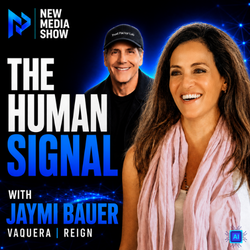
In Episode #682 of the New Media Show, Host, Rob Greenlee talks with growth and brand strategist Jaymi Bauer. Jaymi is CEO and co-founder of Vaquera Group, creator of Resonance Design, and founder of a new women’s vitality venture called Reign.Care.
She and Rob previously worked together at Microsoft during the Zune and Xbox eras, giving both a long view of how technology continually reshapes media and human behavior.
The conversation is not anti-AI. It is about understanding where AI is powerful and where human creators may still have the advantage.
The Human Signal
Jaymi states that humans feel trust before they intellectually recognize it. We respond to tone, presence, energy, emotion, authenticity, and whether something feels genuine. AI can increasingly reproduce human language, imagery, voices, and creative patterns, but Jaymi believes audiences will continue seeking something deeper: content rooted in real human experience.
Her advice to creators is simple: Become better at AI while becoming even more human. AI as Amplifier, Not the Source
Rob and Jaymi explore AI as a creative and production layer rather than the original source of meaning.
AI can:
Research faster
Organize ideas
Improve production
Expand visual possibilities
Help creators distribute content
Personalize discovery
Build new interactive experiences
But the strongest output still begins with a strong human seed: an idea, experience, perspective, story, or creative intention.
Jaymi shares her experience of heavily using AI on a book proposal. The result was polished, but she felt it had become hollow and disconnected from her own creative voice. That became a reminder that efficiency does not automatically create resonance.
Why Human Content May Become Premium
As synthetic media becomes harder to distinguish from human-created media, Rob raises the possibility that creators may eventually label content as human-hosted or human-created, rather than simply labeling AI content.
Jaymi believes genuine human interaction may eventually feel more valuable precisely because it becomes less common.
That could increase the value of:
Live conversations
Human-created storytelling
Live music and events
Real relationships
Distinctive personal perspectives
Physical experiences
Trusted communities
The future may not be human versus AI. It may be human creativity amplified by AI.
Creators Need AI Literacy
Jaymi strongly advises creators not to ignore AI. Her view is that creators should learn the tools, experiment with them, understand their limitations, and explore what they make possible. But they also need stronger critical thinking and editorial judgment.
Rob and Jaymi discuss how experienced professionals may have an advantage here because they have lived through multiple cycles in technology, media, business, and the economy.
Knowing when AI is wrong, when to stop refining, what matters, and what audiences actually value may become increasingly important skills.
AI Changes Discovery Too. AI is not only creating content. It is increasingly sitting between creators and audiences.
Rob discusses how platforms such as YouTube use AI to analyze media, understand content, personalize recommendations, and decide who should see what.
That means creators are entering an environment where AI may influence:
Creation
Editing
Distribution
Metadata
Search
Recommendations
Audience targeting
Personalization
The creator still provides the human idea, but AI increasingly shapes how that idea reaches the world.
A More Interactive Media Future
The conversation also explores AI-powered audience participation. Rob describes emerging platforms where synthetic personalities, expert knowledge bases, and human audience members can participate in shared conversations.
Instead of traditional one-way media, future shows could include creators, audiences, and AI agents discussing topics together.
That could make podcasts, livestreams, sports media, education, and communities considerably more interactive.
Discussion Highlights
-What Jaymi means by the “human signal”
-Why trust is often felt before it is understood
-AI-generated media versus human-created media
-Why creators should become “superhuman,” not anti-AI
-AI as a creative amplifier
-The importance of critical thinking and editorial judgment
-Why AI-generated work can feel polished but hollow
-How experienced professionals can work effectively with AI
-AI’s growing role in discovery and recommendation
-Personal LLMs and creator knowledge models
-Human and AI participants inside future media experiences
-Why live and human-created experiences could become premium
-The possibility of labeling media as human-hosted
-Creativity, trust, and relationships as long-term advantages
Chapter Markers
00:00 Why the human signal matters
01:32 Introducing Jaymi Bauer
02:48 What is the human signal?
05:35 Can AI reproduce human connection?
09:15 Staying human while using AI
11:22 Collective AI knowledge versus individual human knowledge
13:30 Why audiences may eventually reject synthetic sameness
16:04 Will AI-generated entertainment satisfy us?
18:35 AI as a new creative tool
21:05 Lessons from Xbox and immersive media
23:10 Why gamers still want human creativity
25:10 How humans remain valuable
26:38 The dystopian side of AI
28:10 Could AI eventually give humans more freedom?
30:05 Creativity as a human advantage
31:15 Why creators need AI literacy
33:15 Becoming “superhuman”
34:25 Jaymi’s AI-generated book proposal mistake
36:00 Using AI as a first draft
37:20 Better prompts start with better human thinking
38:25 When AI becomes inefficient
40:20 Humans as AI tutors and experts
42:15 What happens when AI gains real-world experience?
45:10 Human truth and durable brands
48:10 AI becomes the discovery layer
51:00 Personal LLMs and expert AI models
52:20 AI-powered audience participation
55:00 Humans and AI in the same conversation
57:10 AI companionship and relationships
59:55 Will human-created media become premium?
01:01:05 Hybrid human and AI production
01:03:10 Where to find Jaymi
01:04:00 Jaymi’s new vitality venture
01:05:40 Closing thoughts
Jaymi Bauer Guest Links:
Jaymi Bauer on Substack
https://jaymibauer1.substack.com
“The Human Signal”
https://jaymibauer1.substack.com/p/the-human-signal
Vaquera Group
https://vaquera.co
Reign
https://reign.care
About the Host: Rob Greenlee is a 2017 Podcast Hall of Fame inductee, Chair of the Podcast Hall of Fame, founder of Trust Factor Lab, and longtime new-media executive, creator, strategist, and industry leader.
Through The New Media Show, Rob explores the changing intersection of podcasting, video, creator-led media, artificial intelligence, platforms, audience ownership, trust, monetization, and the future of human-created media.
Host and Show Links
New Media Show
https://newmediashow.com
New Media Show on YouTube
https://youtube.com/@TheNewMediaShow
Rob Greenlee
https://robgreenlee.com
Rob Greenlee on LinkedIn
https://www.linkedin.com/in/robgreenlee
Podcast Hall of Fame
https://podcasthall.com
AI Disclosure
AI tools were used to assist with organizing and editing to remove filler words; this episode description was created from the completed full transcript of episode #682. The recorded conversation, human performances, perspectives, editorial direction, and final responsibility for the episode remain with Rob Greenlee and Jaymi Bauer. The New Media Show is human-hosted.
Podcast: Play in new window | Download
Subscribe: Apple Podcasts | Android | Podcast Index | RSS
Podcast (audio): Play in new window | Download
Subscribe: Apple Podcasts | Spotify | Android | Podcast Index | RSS
 Should every use of AI in a podcast, video, or creator workflow be disclosed?
 In episode 665 of the New Media Show, hosted by 2017 Podcast Hall of Famer Rob Greenlee, Rob talks with Ashley Christenson, also known as Ashni, for a deep conversation about one of the most important questions facing podcasting, streaming, creator media, startups, and traditional media right now:
 In episode 663 of the New Media Show, hosted by 2017
  On
On