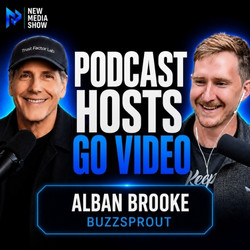
 In Episode 681 of the New Media Show, host Podcast Hall of Famer Rob Greenlee welcomes Alban Brooke, Head of Marketing at Buzzsprout, for a deep conversation about one of the biggest structural changes in podcasting: the evolution of podcast hosting from audio-file distribution to a broader audio-and-video creator infrastructure.
For most of podcasting’s history, the hosting model was relatively straightforward. A creator uploaded an audio file, the host generated an RSS feed, and that feed distributed the episode to listening apps worldwide.
That podcast hosting model is changing.
Video is once again becoming a significant part of podcasting, and podcast hosting platforms are being asked to do much more than store an MP3 and maintain an RSS feed. They increasingly need to manage video encoding, HLS streaming, direct platform connections, YouTube publishing, Spotify video, Apple Podcasts video, transcripts, analytics, AI-assisted publishing tools, and the traditional audio experience simultaneously.
Buzzsprout, which launched in 2009 as an audio-only podcast host, has now made a major move into video. Alban explains that the turning point was Apple’s decision to support HLS video streaming into Apple Podcasts.
Once Apple committed to HLS, Buzzsprout saw an opportunity to preserve one of podcast hosting’s original promises:
“Upload once and let the hosting platform handle the complexity of getting the show everywhere.”
Buzzsprout’s current video workflow allows creators to upload video and distribute it to Apple Podcasts, Spotify, and YouTube while continuing to deliver audio to traditional podcast apps.
The technology underneath that process, however, has become much more complicated.
A podcast host may now be managing RSS feeds, HLS playlists, multiple video resolutions, platform APIs, direct uploads, audio extraction, transcripts, and the different requirements of Apple, Spotify, YouTube, Amazon, iHeart, and other services.
Alban argues that creators should not have to understand most of that.
If podcast hosting is doing its job properly, the technical complexity should disappear into the infrastructure. Creators should be able to concentrate on making the show.
That leads Rob and Alban into a larger discussion about RSS and what it still represents.
RSS itself is not magical, Alban says. What matters is what RSS enables: a direct and portable connection between creators and their audiences. A creator using an open podcast feed can switch from one hosting company to another without rebuilding their audience from scratch. The relationship is not entirely controlled by a recommendation algorithm or a single platform. Alban contrasts this with YouTube and other social platforms, where algorithms ultimately determine how much of a creator’s content reaches subscribers.
A creator can build a large audience on a platform and still experience dramatic changes in reach when the algorithm, product strategy, or monetization model changes.
Podcasting offers something different.
Alban describes media distribution as a spectrum ranging from discovery to delivery. At one end are platforms such as TikTok and YouTube, which are extremely effective at helping users discover content. The platform decides what it believes each person wants to see next.
At the other end are systems such as RSS and email, where the user intentionally subscribes and expects to receive what that creator publishes.
The opportunity for modern creators may be to use both.
YouTube, social video platforms, and algorithmic platforms can enable discovery. RSS can provide reliable delivery and audience portability after that relationship is established.
That combination may become one of podcasting’s greatest advantages.
HLS, RSS and the Future of more Open Video Podcasting
Rob and Alban explore how HLS video could extend those same open-distribution principles into video.
Apple’s implementation currently involves a direct API relationship, but the podcast ecosystem is also experimenting with the alternate enclosure tag in RSS, which can place another media format inside the RSS feed.
Buzzsprout has already experimented with alternate enclosures on selected shows, although Alban explains that the company is approaching broader implementation carefully because video creates dramatically larger bandwidth demands than audio.
A bot downloading thousands of MP3 files is one problem. A bot repeatedly requesting multi-gigabyte video assets is another larger issue.
The larger objective, however, remains open distribution.
Alban believes HLS has the potential to enable multiple podcast applications to support video without forcing creators to confine their entire video audience to a single closed platform.
Can Video Damage the Audio Experience?
The conversation then turns to one of the most important creative questions raised by video podcasting. What happens to audio listeners when the video version becomes the source for both experiences?
Alban shares an example of watching a video podcast on Netflix where George Clooney and the host repeatedly discussed an object visible on camera without ever explaining what it was.
A viewer understood the conversation. An audio listener would have had no idea what they were discussing. That is exactly the kind of problem Alban wants creators to avoid.
His recommendation is that podcasts remain audio-first in their communication, even when video is an important part of the production.
That does not mean ignoring video.
Creators can use cameras, sets, graphics, demonstrations, lighting, and other visual elements. But when something important is happening on screen, the host should provide enough verbal context that the audio listener can still follow the conversation.
Rob raises the other side of the issue.
There is a real difference between producing a video podcast and producing a highly visual YouTube show.
YouTube creators may use graphics, demonstrations, rapid editing, screen captures, text, and visual storytelling that cannot realistically be translated into audio. If every visual element must work perfectly for someone with their eyes closed, video creativity can become constrained.
That may eventually create two related but distinct production approaches: shows built as unified audio/video podcasts and shows designed primarily as visual media.
Why Platforms Want Video
Alban believes the major platforms have obvious reasons for encouraging video. Video keeps audiences looking at the screen.
YouTube, Spotify, Instagram, TikTok, and other platforms benefit when users remain inside their applications, continually moving from one piece of content to the next.
Short-form vertical video takes this even further.
Alban says he deliberately limits his own use of platforms such as TikTok and Instagram Reels because he finds the experience almost too effective at holding attention.
Audio works differently.
A podcast can accompany the listener while running, driving, traveling, cleaning, mowing the lawn, or simply living life.
Alban describes audio as a companion to life, while highly addictive video shorts platforms will increasingly compete to become the dominant activity itself.
We should remain strongly optimistic about audio.
Why Apple’s Move Changed the Market
Rob asks why Apple chose this moment to place renewed emphasis on video, even though video podcasts have technically existed within Apple’s ecosystem for many years.
Alban points to several forces coming together. YouTube has aggressively embraced podcasts and repeatedly highlighted the enormous amount of podcast viewing happening across its platform.
Spotify has expanded its video strategy.
Meanwhile, members of the open podcasting community have spent years exploring HLS as a more practical way of distributing video.
Once Apple embraced HLS, Buzzsprout concluded that the technology had enough platform support to justify a major investment.
Buzzsprout then built its video product around simplifying distribution across Apple Podcasts, Spotify, YouTube, and traditional audio apps.
Why 1080p Video Matters
Buzzsprout also decided to support 1080p video, something Rob sees as increasingly important as podcasts move from phones and laptops onto large television screens. HLS can provide different video streams depending on the device and connection.
A mobile device (phone, pad, or glasses) may not need the same resolution as a large television or large-screen laptop or desktop computer.
But as Apple Podcasts expands onto Apple TV and YouTube continues to report substantial podcast consumption on television screens, creators need source video that looks good in the living room.
Rob and Alban agree that this is another sign that podcast distribution is becoming much broader than that of traditional listening apps.
Audio Is Not Going Away
Despite Buzzsprout’s investment in video, Alban does not believe every podcast needs cameras. Some content is inherently better as audio. Scripted audio, documentary storytelling, intimate conversations, educational programming, and many other formats can deliver everything the audience needs without video.
Alban does not believe audio needs a technological gimmick to survive.
Spatial audio, immersive sound, and advanced codecs can create interesting experiences, but the central power of podcasting remains remarkably simple:
“The human voice and a compelling story.”
Good audio recorded decades ago can still be powerful today because the idea, voice, and storytelling remain meaningful.
Video is therefore additive rather than a replacement for audio.
Is Podcast Hosting Becoming a Commodity?
Rob then challenges Alban with another industry question:
Simply storing a media file is no longer difficult. Most hosting platforms can generate RSS feeds, distribute episodes, and provide common publishing features.
Alban agrees that hosting, narrowly defined as file storage, can look commoditized. But he argues that this misses the bigger job a podcast-hosting company should perform.
Buzzsprout sees its role as helping creators successfully navigate the entire process.
That includes technology, education, human support, distribution, publishing assistance, video, analytics, transcripts, and reducing the emotional and technical friction involved in putting something meaningful into the world. The competitive advantage is not simply storing the file. It is helping the creator succeed.
AI Should Remove Work, Not the Human
That philosophy carries directly into the episode’s discussion about artificial intelligence.
Buzzsprout already uses AI to help creators generate titles, descriptions, social content, blog material, chapter markers, and transcripts. Alban is comfortable with AI handling parts of production that creators may not enjoy. Buzzsprout’s own materials identify its Co-Host AI tools as assisting with publishing tasks, including titles, descriptions, chapters, and supporting content.
What he does not want AI to replace is the reason many people became creators in the first place.
Alban enjoys researching an idea, thinking about it, writing, talking with people, recording conversations, and producing something that reflects human experience.
If AI can clean audio, transcribe the episode, or reduce repetitive production work, that can be useful.
If it replaces the host, opinion, conversation, or creative process entirely, something important may be lost. Alban compares his preferred relationship with AI to using a calculator.
The technology is valuable. Yet, blindly refusing to use it entirely could be unnecessarily limiting. But just because a technology can perform a task does not mean the creator should hand over every task.
The important question is:
“Which parts of creating matter to you enough that you want to remain the person doing them?”
AI, Disclosure and Audience Trust
The deeper issue is trust.
Alban describes hearing what he believed was an AI-generated host-read advertisement in a podcast he regularly listened to. When he later asked the creator about AI and received a categorical denial of using it, Alban’s confidence in the show changed.
The problem was not simply that AI may have been used. The problem was the perception that the creator was not being transparent about it.
Rob and Alban agree that disclosure becomes increasingly important as synthetic voices, AI-written scripts, avatars, automated media, and cloned personalities become harder to distinguish from human-created content.
“Rob suggests that the industry may eventually move beyond labeling AI toward verifying or certifying what is human.”
As synthetic AI-generated audio and video content becomes more common, audiences may increasingly value signals showing that a conversation, performance, appearance, or relationship involves real humans.
That could increase the importance of live events, face-to-face meetings, physical communities, concerts, coffee shops, and other experiences where human presence is difficult to fake.
The Return of Offline Experiences
The episode broadens into a discussion about younger generations and technology.
Alban notes that some younger people are becoming interested in non-connected devices, point-and-shoot cameras, film cameras, books, and other technologies that do not constantly demand attention.
Rob sees similar interest developing around discontinued devices such as the Microsoft Zune portable media player devices.
The larger trend may represent a reaction to always-connected life.
Technology gives creators unprecedented reach, but human relationships still develop through attention, responsiveness, shared experiences, and time spent together.
That principle also connects back to podcasting.
Podcasting’s open architecture allows content to flow across applications and devices while maintaining a direct creator-to-audience relationship.
As Alban sees it, the strongest future for podcasting combines the best of both worlds:
“Open delivery through podcasting, algorithmic discovery through larger platforms, video when it adds value, audio when audio is enough, AI where it removes friction, and humans at the center of the creative relationship.”
Topics Covered in This Episode
– Why Buzzsprout moved from audio-only into video podcasting
– Apple HLS video and the turning point for podcast hosts
– Upload-once distribution across Apple, Spotify, YouTube, and audio apps
– Why technical complexity should disappear for creators
– RSS as creator ownership and audience portability
– Discovery versus reliable delivery
– Algorithms compared with open podcast distribution
– Alternate enclosures and open video
– Protecting audio listeners when video is added
– Unified audio/video podcast experiences
– Video podcasts versus highly visual YouTube productions
– Why platforms want creators producing more video
– Short-form video and attention
– Why audio remains a companion medium
– 1080p video and television podcast consumption
– Why audio-only podcasting remains healthy
– Is podcast hosting becoming a commodity?
– Buzzsprout’s creator-support philosophy
– AI-assisted podcast production
– Which parts of creation should remain human
– AI voices, disclosure, and audience trust
– The possibility of verified-human media
– Younger generations and offline technology
– The renewed appeal of disconnected devices
– Open podcasting in the Liquid Content Era
Chapter Timestamp Markers
00:00 Welcome to The New Media Show Episode 681
00:24 Podcast hosting is moving beyond the audio file
01:18 Buzzsprout enters the video podcast era
02:00 Introducing Alban Brooke of Buzzsprout
03:15 What changed Buzzsprout’s thinking about video?
04:01 Why Buzzsprout spent years focused on audio only
04:50 Apple HLS video becomes the turning point
05:33 Upload once and distribute video and audio everywhere
06:00 Podcast distribution becomes technically more complicated
07:00 Why the hosting platform should hide the complexity
09:21 Podcasters increasingly do not know what RSS is
10:53 Why RSS still matters
11:08 RSS, creator control, and platform algorithm risk
13:08 The difference between podcast delivery and discovery
14:35 Using YouTube for discovery and RSS for audience delivery
15:37 HLS brings open distribution principles to video
16:49 Alternative enclosures and open video podcasting
17:18 The bandwidth and bot problem with video
18:04 Rob’s dual audio and video RSS strategy
19:20 The tension between MP4 video and HLS
20:15 What happens when video becomes the source of the audio?
20:52 The Netflix example of a broken audio experience
22:01 Why adding video can unintentionally hurt audio listeners
22:50 Alban’s case for audio-first communication
23:52 Why unified audio, video, and transcripts need to stay in sync
25:04 Video podcasts versus YouTube-first visual shows
26:15 Why platforms keep pushing creators toward video
27:15 The addictive power of short-form vertical video
28:32 Audio as a companion to real life
29:20 Why Apple chose this moment to emphasize video
30:34 The podcast industry’s push toward HLS
31:03 YouTube and Spotify increase competitive pressure
32:00 Why Apple’s HLS implementation changed Buzzsprout’s plans
33:23 Buzzsprout goes all-in on simplified video distribution
34:03 Why Buzzsprout chose 1080p
35:04 Podcast consumption moves onto television screens
35:41 How HLS adapts video quality to different devices
37:09 Apple TV and the big-screen podcast opportunity
38:43 Could HLS eventually replace audio delivery?
39:16 Why Alban believes audio-only podcasting remains strong
40:35 Video audiences can be additive rather than replacements
41:14 Could audio become more immersive?
42:02 Spatial audio and the history of immersive sound
43:03 Why the human voice matters more than audio technology
44:02 Does audio even need to compete with video?
45:33 Video is additive, not the death of audio
46:51 Is podcast hosting becoming a commodity?
48:00 Hosting versus full creator infrastructure
49:03 Removing technical and emotional barriers for creators
50:14 Why human support still differentiates podcast platforms
51:17 Where AI fits into podcast hosting
52:00 Buzzsprout Co-Host AI and production assistance
52:33 Using AI for tasks creators do not enjoy
53:32 Protect the parts of creating you actually love
54:28 Rob’s use of AI in pre-production and post-production
55:04 Why flowing human conversations resist scripting
55:43 The value of unscripted New Media Show conversations
56:27 AI is already capable of strong writing
57:06 Why the act of creation still matters
58:47 Creator attitudes toward AI become increasingly divided
1:00:44 Using AI like a calculator
1:02:09 AI-generated host reads and the trust problem
1:03:27 Why undisclosed AI can damage audience relationships
1:04:26 AI use versus dishonesty about AI use
1:05:17 Will we eventually label human-created content instead of AI-generated content?
1:06:19 Why real-world human experiences may become more valuable
1:07:38 Could “Certified Human” become a media signal?
1:08:20 AI avatars, recruiting fraud, and human verification
1:09:21 Trust can take years to build and minutes to destroy
1:10:35 Finding the middle ground on AI
1:11:07 Where AI saves time without replacing the creator
1:12:08 Preserve the human parts that matter
1:13:03 Generational differences around technology and AI
1:14:11 Gen Alpha, point-and-shoot cameras, and rejecting connectivity
1:15:01 Designing intentional distance from addictive media
1:16:18 The unexpected return of the Microsoft Zune
1:17:12 Books, film cameras, and disconnected technology
1:18:19 Human relationships existed before social platforms
1:19:01 Alban’s relationship with social media
1:20:17 Why offline relationships can matter more
1:21:19 Media creation becomes increasingly fragmented
1:22:00 Podcasting as truly liquid and open content
1:22:34 Closing thoughts with Alban Brooke
1:23:00 Where to find The New Media Show
Guest Links: Alban Brooke, Head of Marketing, Buzzsprout
Buzzsprout: https://www.buzzsprout.com
Buzzsprout Video Podcasting: https://www.buzzsprout.com/features
Buzzcast: https://buzzcast.buzzsprout.com
Alban Brooke on LinkedIn: https://www.linkedin.com/in/albanbrooke
Alban Brooke is Head of Marketing at Buzzsprout and co-host of Buzzcast, where he discusses podcast technology, creator trends, industry developments, and practical strategies for podcasters.
Host, Rob Greenlee, and New Media Show Links
New Media Show: https://newmediashow.com
New Media Show on YouTube: https://youtube.com/@TheNewMediaShow
New Media Show Audio on Apple Podcasts: https://podcasts.apple.com/us/podcast/new-media-show-audio/id392545649
Rob Greenlee Website: https://robgreenlee.com
Rob Greenlee on LinkedIn: https://www.linkedin.com/in/robgreenlee
Rob Greenlee on YouTube: https://youtube.com/@RobGreenlee
Podcast Hall of Fame: https://podcasthall.com
AI Disclosure Note
AI tools were used to create a video and audio introduction clip, episode images, help organize and edit this episode and summarize its description, and create chapter markers from the completed Episode 681 transcript. The recorded conversation, human performances, guest perspectives, editorial direction, final review, and responsibility for the published content remain with actual humans, Rob Greenlee and Alban Brooke.
Podcast: Play in new window | Download
Subscribe: Apple Podcasts | Android | Podcast Index |
Podcast (audio): Play in new window | Download
Subscribe: Apple Podcasts | Spotify | Android | Podcast Index |
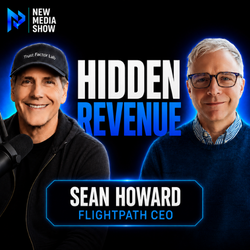 In this episode #686 of the New Media Show, Rob Greenlee talks with Sean Howard, CEO and co-founder of Flightpath.fm, about the growing complexity behind new media podcast advertising and why better forecasting, campaign management, publisher data, and revenue optimization are becoming more important.
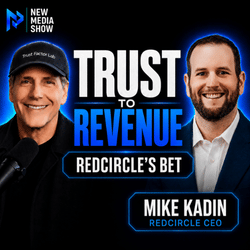 Podcasting has one advantage that much of digital media struggles to maintain: trust.
 In Episode 674 of the New Media Show, Podcast Hall of Fame Host
  In Episode 672 of the New Media Show, host 2017 Podcast Hall of Famer
  “Podcast episode hosting used to be simple. You uploaded an audio file, generated an RSS feed, and distributed your show everywhere. That model still matters, but it is no longer enough for the modern creator economy.”
 Podcasting is entering a new phase, and this episode goes straight into the infrastructure, business models, and platform shifts shaping what comes next.