By Rob Greenlee
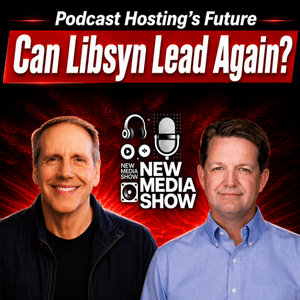
 This article provides context about my comments on New Media Show episode 660 with Libsyn CEO Brendan Monaghan, where we discussed Podcasting 2.0, RSS tag adoption, and the gap between innovation and mainstream platform implementation.
During my recent interview conversation with the Libsyn CEO, I used the word “fringe” when discussing Podcasting 2.0 RSS extension tag ideas. That comment in an extended audio clip was played and discussed on “Podnews Weekly Review“, and understandably, it raised concerns in parts of the podcasting 2.0 community, including Dave Jones and Adam Curry on the Podcasting 2.0 podcast. Let me say this clearly. That was not the right word for me to use, and I regret saying it that way. Not because I am backing away from the broader point I was trying to make, but because the word itself does not reflect how I actually view the work happening in the Podcasting 2.0 and open RSS ecosystem.
The comment came out quickly in a live discussion and did not carry the full context I intended.
What I was trying to describe is something I have repeatedly seen said over the past two decades working with large platforms, hosting companies, and media organizations: there is a real difference between something that is not widely adopted yet and something that is not valuable.
Podcasting 2.0 Innovation Has Real Value
Podcasting 2.0 innovations are valuable. RSS namespace expansion, new tags, and experimentation around monetization, identity, transcripts, funding, and distribution all matter. This is where much of the real innovation in podcasting is happening.
At the same time, many of these capabilities have been around for several years, in some cases for close to five years. That historical context matters. My comment was not about the value of the ideas themselves. It was about the pace and pattern of adoption, especially among larger platforms.
When I used the word “fringe,” I was referring to the broader set of emerging and evolving tag ideas within the Podcasting 2.0 initiative.
There are many tags and concepts at different stages of maturity, market fit, timing, and implementation. Not all of them have broad agreement or adoption, even within standards-focused efforts like the Podcast Standards Project. From a product and platform perspective, this creates a spectrum of adoption rather than one unified standard that everyone has fully embraced.
What I Was Trying to Say
What I meant is that market fit and timing play a major role in what gets adopted at scale. Larger podcasting platforms tend to move more deliberately. Their decisions are shaped by user experience, engineering resources, monetization models, product stability, support complexity, and business priorities.
That often means only a subset of new capabilities gets integrated into mainstream products at any given time. That has been the pattern over the past several years. But it is also important to say this pattern is changing.
Momentum Started Very Slow, But Is Building
Over the past year or so, we have started to see real momentum around some Podcasting 2.0 tags and capabilities. More platforms are experimenting. More tools are supporting them. More creators are becoming aware of what is possible and how these features can be used in real workflows.
That has been great to see
I believe we will continue to see more adoption of certain RSS tags as platforms, tools, and creators find clearer ways to integrate them into everyday use.
Some Tags Are Seeing More Adoption
You can already see this progression in parts of the ecosystem.
Tags like transcript, chapters, and person have seen meaningful adoption because they provide immediate and understandable value. The Alternative Enclosure tag is being more widely adopted across platforms, too. They improve accessibility, discovery, context, and creator attribution. The funding tag has gained traction within parts of the ecosystem, especially among creators and platforms exploring alternative monetization models. The value tag, which supports value-for-value and streaming payment models, has been adopted within specific apps and communities, though it has struggled more recently and has not yet become mainstream across larger platforms. Other tags and ideas are still at an earlier stage. Some are being tested. Some are evolving. Some are still looking for the right use case that will drive broader adoption. That is what I meant by a spectrum of innovation.
Innovation and Adoption Are Not the Same Thing
Podcasting operates across two layers simultaneously.
There is an innovation layer, where developers, independent platforms, and forward-thinking creators create and test new ideas. Then there is a platform layer, where those ideas are evaluated, prioritized, supported, and integrated into products used by millions of people. The gap between those two layers is where much of the tension comes from.
I have seen this pattern many times. Podcasting itself began outside the mainstream.
Mobile listening took time to become the default. Video podcasting has gone through multiple cycles before finding its current role. Programmatic advertising in audio took years to mature. Innovation usually moves faster than adoption. Adoption follows when user demand, product fit, creator benefit, and business alignment come together.
That is where many Podcasting 2.0 capabilities have been.
My View of Podcasting 2.0 and the Podcast Standards Project
I also want to be clear that Podcasting 2.0 and the Podcast Standards Project are not the same thing. They overlap in some areas, but they do not necessarily embrace every tag or idea in the same way.
That is part of the larger point.
When standards-oriented efforts evaluate which capabilities to support, it shows that this is not simply a question of innovation versus resistance. It is about maturity, usefulness, interoperability, timing, and market fit. That is the context I was trying to convey, though I did not do so well at the time.
I Respect the Podcasting 2.0 Community
So when I used the word “fringe,” I was trying to describe how some organizations have historically perceived ideas that had not yet reached scale or product integration. But I understand how that word sounded dismissive of Podcasting 2.0, and that is not how I really see it.
I respect and appreciate the innovation and work happening through PodcastIndex.org, Podcasting 2.0, and the broader open podcasting community, including the work and advocacy of Adam Curry, Dave Jones, Daniel J. Lewis, and many others.
The opportunity now is to build on the momentum emerging and move the most valuable ideas toward broader adoption. That means making these capabilities easier to use, improving listener experiences, aligning them with sustainable business models, and demonstrating clear value at scale. That is how innovation moves from experimentation into everyday use.
My Role in the Conversation
I do not want to frame this as one side versus another. I am focused on helping connect what is being built with what is actually being adopted and used at scale.
That is the conversation we are having every week on the “New Media Show“. Join us LIVE on Weds, 3 pm PST/6 pm EST, or on demand in all the podcast apps and live on YouTube.com/@robgreenlee, LinkedIn.com, Facebook.com, and X.com
So, yes, I regret the word “Fringe” I used. But I stand by the broader point that there has been a gap between innovation and adoption in podcasting over the past several years. The good news is that momentum is building, and that gap is starting to close. That is where the real opportunity is for all of us in this industry.
About the Author
Rob Greenlee is a 2017 Podcast Hall of Fame inductee and Chair, a global new media leader who bridges podcasting’s human roots with its AI-driven future. As founder of Trust Factor Lab and host of the “New Media Show” and “Spoken Human”, Rob helps creators start, grow, monetize, and future-proof their content. He’s held leadership roles at Microsoft, Spreaker, Libsyn, StreamYard, and PodcastOne, and serves as Chairperson of the Podcast Hall of Fame. Learn more at RobGreenlee.com and join the Trust Factor Lab Creator/Podcast Services.
Personal note: I used AI tools to help organize this article and hand-edited it; the views, clarifications, responsibility, and industry perspective are mine. I have been working in podcasting and platform adoption for more than two decades, and this article reflects my own position. The original word choice was mine, and so is the clarification.
 “Podcast episode hosting used to be simple. You uploaded an audio file, generated an RSS feed, and distributed your show everywhere. That model still matters, but it is no longer enough for the modern creator economy.”