WATCH OR LISTEN · EPISODE 690
Watch video | Listen to audio | Read show notes
Watch video
Podcast: Play in new window | Download
Subscribe: Apple Podcasts | Android | Podcast Index | RSS
Prefer audio? Listen here.
Open audio in a new window | Download audio
Follow the audio podcast: Apple Podcasts | Spotify | RSS
Show notes
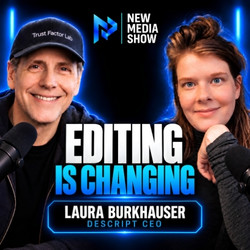 In New Media Show #690, Host Rob Greenlee, Podcast Hall of Famer and Founder of TrustFactorLab.com, joins Laura Burkhauser, CEO of Descript (https://www.descript.com), to explore how AI is changing the way creators edit, produce, and share their work.
As AI takes on more production tasks, what becomes more valuable about the human creator? Laura and I discuss creative direction, storytelling, authenticity, audience trust, and the role of tools such as Descript’s Underlord. The conversation also looks beyond editing to the business of creating media and the pressure to show up across more platforms.
From Editing to Creative Direction
We start with a question many creators are facing: is editing becoming more like directing?
Laura distinguishes between people whose craft is editing and people whose craft is the story they want to tell. Both can benefit from AI, but they may want very different levels of control.
For an editor, the small decisions are part of the art.
For a storyteller, editing may be the obstacle between recording an idea and sharing it with an audience. We discuss why a clear creative vision still matters.
Asking AI to edit a podcast can produce a usable result, but communicating a specific perspective, reviewing its choices, and refining the work are what help a creator make something distinctive.
Let AI Handle the Friction
Laura’s approach to AI starts with understanding what creators actually want help doing.
Creators want relief from repetitive production work while keeping their voice, vision, and story. Laura describes Descript’s philosophy as “struggle with your art, not with your tools.”
That leads to a discussion about the promises AI companies make and the trust they can lose when those promises overlook how creative work happens.
Rob Greenlee shares his experience moving from assembling radio shows by hand to using Descript in my current workflow. We explore how creators can choose the right balance of manual editing and AI assistance for the content they want to make.
Authenticity and the Choices Behind an Edit
Does editing make a conversation less authentic? Laura argues that thoughtful editing can bring its meaning into sharper focus.
A reaction shot or a well-timed close-up can help an audience understand the emotion in a conversation. The question is whether an edit serves what happened between the people involved.
We also talk about the difference between being authentic and performing authenticity online. Showing up as yourself can build connection, but it can also leave creators exposed to criticism.
Laura explains why a recognizable human presence and community engagement matter to her.
Rob connects that discussion to my work with Trust Factor Lab and the challenge of building trust as more synthetic media enters the mix is the growing opportunity.
Start Creating Before Expecting a Business
Laura was a Descript customer before she joined the company. Editing a podcast with a friend showed her she could put her own humor and perspective into the world without mastering a complicated production tool.
Her practical advice is to begin by recording something.
The opportunity is to talk about a problem you understand, a subject you care about, or an issue you can explore with another person. Then edit it, share it, and keep going long enough to learn from the experience.
We discuss how the expectation of immediate revenue can get in the way of the authentic creator process.
Creating media can support a business even when the media itself is not the product. For coaches, consultants, founders, and other professionals, a video or podcast can show their expertise and help start a relationship that leads to work.
Community, Revenue, and Reaching the Right People
Our business discussion moves into audience support, Patreon, and sponsorship opportunities.
Laura points to community support as one possible path for working creators. We also explore why a business serving a specific audience may be a better sponsorship prospect than a broad advertising buyer.
Local businesses and companies serving a particular interest give us examples to consider.
The discussion focuses on understanding your audience, what they care about, and which relationships could create value.
We also look at why more companies are building their own media operations and why creators feel pressure to produce both long-form conversations and short clips.
Algorithms and What Comes Next for Descript
Laura describes being intentional about her own media consumption, including turning off YouTube recommendations. I share how I use both subscriptions and algorithmic discovery.
A broader conversation starts about personalization.
Laura argues that the goals given to an algorithm matter. A system rewarded for attention does not automatically distinguish between an experience that helps someone and one that keeps them engaged through anger or distrust.
We close with Laura’s BIG Direction for Descript:
Helping creators across more of their content workflow, including identifying the subjects they want to own, building a library of useful material, publishing across platforms, and learning from what works. Laura describes that as a direction for future development as creators manage growing demands on their time.
Key takeaways:
AI can make production easier, but your perspective still gives people a reason to listen. Use the tools to reduce friction, make deliberate creative choices, and invest in the relationships that give your work lasting value.
Key topics
– AI editing, Underlord, and the changing creator workflow
– The difference between editing as a craft and editing as a production task
– Creative direction, specific prompts, and human judgment
– Reducing repetitive work while preserving a creator’s voice
– Authenticity, thoughtful editing, and audience trust
– Getting started without expecting immediate monetization
– Using media to support a coaching, consulting, or founder-led business
– Community support, Patreon, and targeted sponsorships
– YouTube discovery, subscriptions, and personalization
– Descript’s direction beyond editing into broader content workflows
Chapter timestamps
– 00:00 AI workflows and the value of the human creator
– 02:00 Meet Descript CEO Laura Burkhauser
– 03:00 Is editing becoming directing?
– 05:00 When storytelling is the creator’s main craft
– 07:00 Creative vision and directing AI
– 10:00 Standing out through your voice and perspective
– 12:00 AI promises, creator trust, and tool friction
– 14:00 From manual production to AI-assisted editing
– 16:00 Authenticity and the role of a good editor
– 18:00 What does it mean to be authentic online?
– 21:00 Technology, human needs, and useful AI
– 24:00 Trust Factor Lab and finding a balance with AI
– 26:00 Laura’s experience as a Descript customer
– 28:00 Record, edit, share, and build confidence
– 30:00 Does pressure to monetize hold creators back?
– 32:00 Content as a way to grow a business
– 35:00 Community support and creator revenue
– 36:00 Local businesses and targeted sponsorships
– 39:00 YouTube recommendations and intentional viewing
– 42:00 Personalization, engagement, and human outcomes
– 46:00 What comes next for Descript
– 48:00 Closing thoughts
Guest Laura Burkhauser
Laura Burkhauser is CEO of Descript. In this conversation, she shares her perspective as a technology leader, a humanist, and a former Descript customer who discovered the creative possibilities of editing her own podcast.
– Descript: https://www.descript.com
– Descript Underlord: https://www.descript.com/underlord
– Laura Burkhauser on the Descript blog: https://www.descript.com/blog/author/laura-burkhauser
Host Rob Greenlee
Rob Greenlee is the founder/builder of Trust Factor Lab (https://TrustFactorLab.com), host of New Media Show, and a 2017 Podcast Hall of Fame inductee and Chair. His work connects podcasting, video, creator platforms, audience trust, and the media business.
– New Media Show: https://newmediashow.com/
– New Media Show on YouTube: https://youtube.com/@TheNewMediaShow
– Rob Greenlee: https://robgreenlee.com/
– Rob Greenlee on LinkedIn: https://www.linkedin.com/in/robgreenlee
– Podcast Hall of Fame: https://podcasthall.com
– Adore Network Audio: https://www.adorenetwork.com/show/new-media-show-audio
– Adore Network Video: https://www.adorenetwork.com/show/new-media-show-video
– Apple Podcasts Audio: https://podcasts.apple.com/us/podcast/new-media-show-audio/id392545649
– Apple Podcasts Video: https://podcasts.apple.com/us/podcast/new-media-show-video/id392545647
AI disclosure
AI tools helped organize and draft these show notes from the completed Episode #690 transcript. Rob Greenlee and guest retain all editorial responsibility. The New Media Show is human-hosted with human guests. AI is used for light editing of the actual audio and video media files.
 In New Media Show #689, I’m joined by