“Is video podcasting making creators more profitable, or simply making their content more valuable to YouTube, Spotify, Apple, and other platforms? Plus the brewing AI content vs Human content battle that is developing”
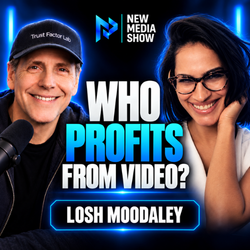 In New Media Show #691, Host Rob Greenlee, Founder of TrustFactorLab.com, and Podcast Hall of Famer, welcomes guest Losh Moodaley, a podcast sponsorship and brand partnerships strategist.
They together explore the economics of video podcasting, creator monetization, platform control, audience ownership, and the future of human-centered media.
Losh brings more than 15 years of commercial experience across entertainment, retail, sports, and brand partnerships. Her article, The Price of Visibility: The Hidden Economics of Podcast Video, raises an important question for independent creators: when does investing in video actually make business sense?
What starts as a discussion about podcast profitability expands into a larger conversation about the changing definition of podcasting, direct sponsorships, live commerce, AI-generated media, human creativity, and audience trust.
Who Really Profits From Video Podcasting?
Video has become a major driver of podcast discovery. YouTube is attracting podcast audiences, Spotify and Apple are expanding their video capabilities, and creators are being encouraged to produce more visual content.
But financial tension underlies that growth.
Adding video often means additional equipment, production time, editing, graphics, lighting, and publishing work. Those costs do not automatically produce equivalent revenue.
Losh explains why creators should evaluate video as a business investment rather than simply follow platform expectations.
The question becomes: Are you building a more profitable creator business, or helping platforms generate additional viewing time?
The Video Threshold: When Does Video Pay for Itself?
Losh introduces her Video Threshold framework, which identifies the point where additional video production costs are justified by the revenue and business value created.
She discusses research suggesting that producing a video podcast can cost substantially more than an audio-only show, with one industry analysis finding production costs approximately 3.6 times higher.
But the economics vary considerably depending on how a creator earns revenue.
- A podcast dependent on CPM-based advertising may need a very large audience to support professional video production.
- A smaller show generating consulting clients, direct sponsorships, memberships, or product sales may justify video much sooner.
Video can be valuable without paying for itself through advertising alone.
Video as a Customer Acquisition Strategy
One of the most useful distinctions in the conversation is looking at video as marketing and customer acquisition rather than simply another content format.
A YouTube appearance, short clip, or full video episode might introduce someone to a creator for the first time.
But what happens afterward?
Does the viewer become a subscriber, customer, community member, consulting client, or someone who develops a meaningful relationship with the creator?
Rob and Losh discuss why discovery numbers alone cannot answer those questions.
The business value may come from the relationship that develops after someone finds the content.
Own Your Audience Instead of Renting It
The conversation turns toward the growing power of distribution platforms.
YouTube, Spotify, Apple, and other services provide access to enormous audiences, but their business priorities do not always align with those of independent creators.
Platforms optimize for engagement, viewing time, subscriptions, and their own revenue models.
Creators need to think differently: build relationships and assets they can control.
Rob and Losh discuss newsletters, websites, memberships, subscriptions, communities, and direct customer relationships as ways to reduce platform dependence.
They also emphasize owning intellectual property and building a business that doesn’t depend entirely on one distribution company.
Beyond CPMs: Sponsorships, Products, and Community
Traditional podcast advertising remains important, but Losh sees significant opportunity beyond standard host-read advertising and programmatic CPM revenue.
The discussion explores direct brand partnerships, integrated sponsorship experiences, premium offerings, consulting, live events, and audience-supported businesses.
Instead of simply inserting more ads into episodes, creators may develop experiences that connect sponsors and audiences more naturally.
An independent creator with a smaller but highly engaged community may generate substantial business value without competing for millions of downloads.
Audience trust and relevance can become more important than raw scale.
When Video, Community, and Commerce Come Together
The episode moves into live video commerce and a possible future for creator-led media businesses.
Rob Greenlee shares his experience and observations of the fast-growing platform Whatnot, where creators combine live video, merchandise, auctions, audience interaction, and collaborative community events.
That model suggests opportunities for podcasts and creator brands to extend beyond advertising into products, retail, live experiences, and direct transactions.
Losh sees growing potential in combining video, commerce, and community.
The future creator business may not be defined by a single show or distribution platform, but by the relationships and opportunities built around its audience.
Audio and Video Are Different Experiences
Rob brings his experience producing New Media Show in both audio and video for many years into the discussion.
As Apple Podcasts and other platforms adopt HLS streaming and integrated audio-video experiences, creators face new decisions about how to produce their content.
Should the audio and video versions always be identical?
-
Can a visually driven program deliver the same value when someone turns off the screen?
-
Do creators need separate edits to produce the strongest experience in each format?
Rob argues that creators should retain flexibility to build content around the strengths of the medium rather than be forced into one production model.
What Is a Podcast Now?
The conversation also tackles the continuing identity debate around podcasting.
Traditional podcasting was built around open RSS distribution, but audiences increasingly identify long-form conversations on YouTube and even streaming services such as Netflix as podcasts.
Rob Greenlee argues that audience behavior and platform terminology are increasingly shaping what people understand a podcast to be.
Losh and Rob discuss whether the industry can establish common definitions and meaningful measurements as video, streaming, downloads, and social media consumption converge.
Measuring Attention, Outcomes, and Trust
Views, downloads, listening time, impressions, conversions, and customer value each provide a different piece of the picture.
Rob and Losh explore whether the future of creator measurement should place greater emphasis on audience attention, financial outcomes, and return on investment.
They also consider whether AI might eventually help connect fragmented measurement systems and reveal deeper signals about the value of audience relationships.
The discussion returns repeatedly to trust as an important element of creator success, particularly when media is used to build professional authority, relationships, and business opportunities.
AI Media and the Future Human Creator
The second half of the conversation expands into the future of AI-generated and AI-enhanced media.
Rob Greenlee describes three developing categories:
- Fully human-created content.
- Human-created content enhanced through AI tools.
- Fully AI-generated content.
Losh emphasizes the continuing value of human connection, particularly in conversational media where audiences develop relationships with real people.
The conversation then moves into synthetic characters, virtual personalities, immersive storytelling, digital worlds, and the potential for AI-created intellectual property to become part of real-world entertainment and commerce.
As production capabilities expand, imagination, creativity, judgment, responsibility, and ownership may become increasingly important.
Build a Business That Makes Sense for You
Losh closes with practical advice for creators. Do not invest in video simply because platforms encourage it. Consider why you are creating, who your audience is, what value you provide, and how the content supports your goals.
A podcast created as a hobby has different requirements from one designed to generate business revenue.
For creators building a business, consistency, a clear niche, audience trust, sustainable costs, and direct relationships remain essential.
Rob Greenlee also notes that creators should test whether their ideas and workflows are sustainable before making major investments in production and business infrastructure.
The central takeaway:
Video can grow your audience, but audience growth alone does not guarantee a sustainable business. Build for your audience and your own economic goals, not simply the objectives of the platforms carrying your content.
Key topics:
– The real economics of video podcasting
– Why video production can increase costs faster than revenue
– Losh Moodaley’s Video Threshold framework
– Video as customer acquisition and marketing
– Platform incentives versus creator profitability
– Owning audience relationships and intellectual property
– Direct sponsorships and alternatives to CPM advertising
– Community, memberships, products, and live experiences
– Whatnot, live shopping, and creator-led commerce
– Audio versus video production workflows
– HLS streaming and the future of podcast distribution
– YouTube, Spotify, Apple Podcasts, and Netflix
– The changing definition of podcasting
– Attention, ROI, and creator business measurement
– Human trust in AI-enhanced and synthetic media
– Building sustainable creator businesses
Chapter timestamps:
- 00:00 Who profits from video podcasting?
- 02:00 Meet Losh Moodaley
- 06:00 The pressure to move from audio to video
- 07:00 Is video becoming the price of discoverability?
- 10:00 Podcasts move into the living room
- 14:00 The rising production costs of video
- 16:00 Video as a customer acquisition investment
- 18:00 Building revenue beyond traditional advertising
- 20:00 Why creators need to own their audiences
- 25:00 Platform economics versus creator economics
- 28:00 HLS streaming and a video-first future
- 32:00 Direct sponsorships and authentic brand integration
- 36:00 Audience support, memberships, and premium content
- 39:00 Live commerce and the future of creator retail
- 43:00 Why audio and video need different creative approaches
- 47:00 Podcasting’s identity and measurement challenges
- 51:00 Attention, return on investment, and AI measurement
- 54:00 The human trust layer and AI agents
- 56:00 Human-created, AI-enhanced, and synthetic content
- 60:00 Virtual characters, intellectual property, and creativity
- 65:00 Limitless AI production and creative responsibility
- 70:00 Build the podcast around your business goals
- 75:00 Final advice for independent creators
- 77:00 Where to connect with Losh Moodaley
Chapter markers are based on the recording transcript and should be verified against the final edited video.
Guest: Losh Moodaley
Losh Moodaley is a podcast sponsorship and brand partnerships strategist with 15+ years of experience across entertainment, retail, sports, and commercial partnerships.
Her work focuses on helping independent podcasts develop sustainable sponsorship revenue, direct brand relationships, and business models that reflect the value of their audiences.
Connect with Losh:
- LinkedIn: https://www.linkedin.com/in/loshm13/
- The Price of Visibility, Podnews: https://podnews.net/article/the-video-threshold
- Beyond the CPM, Podnews: https://podnews.net/article/beyond-the-cpm-podcast-advertising
Host: Rob Greenlee
Rob Greenlee is the host of New Media Show, founder of Trust Factor Lab, a 2017 Podcast Hall of Fame inductee, and Chair of the Podcast Hall of Fame.
- New Media Show: https://newmediashow.com/
- YouTube: https://youtube.com/@TheNewMediaShow
- Rob Greenlee: https://robgreenlee.com/
- Trust Factor Lab: https://trustfactorlab.com/
- LinkedIn: https://www.linkedin.com/in/robgreenlee
- Podcast Hall of Fame: https://podcasthall.com/
- Adore Network Audio: https://www.adorenetwork.com/show/new-media-show-audio
- Adore Network Video: https://www.adorenetwork.com/show/new-media-show-video
- Apple Podcasts Audio: https://podcasts.apple.com/us/podcast/new-media-show-audio/id392545649
- Apple Podcasts Video: https://podcasts.apple.com/us/podcast/new-media-show-video/id392545647
AI disclosure
AI tools helped organize and draft these show notes from the original episode transcript. The conversation features human participants. Editorial review and final publishing decisions remain with Rob Greenlee.
Podcast: Play in new window | Download
Subscribe: Apple Podcasts | Android | Podcast Index | RSS
Podcast (audio): Play in new window | Download
Subscribe: Apple Podcasts | Spotify | Android | Podcast Index | RSS
 In this episode #686 of the
  Podcasting has one advantage that much of digital media struggles to maintain: trust.
 In Episode 680 of the New Media Show, host Rob Greenlee welcomes Steven Goldstein, founder and CEO of Amplifi Media, for a timely, future-leaning discussion.
 In Episode 677 of the New Media Show, host Rob Greenlee welcomes Dan Granger, founder and CEO of Oxford Road, for a detailed conversation about how personality-led media is changing what brands buy, how audiences are measured, and what the podcast industry must do to support its next stage of growth.
 In Episode 673 of the New Media Show, host 2017 Podcast Hall of Famer
  In Episode 672 of the New Media Show, host 2017 Podcast Hall of Famer
  In episode 669 of the New Media Show, host Rob Greenlee talks with Rob Walch, VP of Podcaster Relations at Captivate and DAX.
 “Podcast episode hosting used to be simple. You uploaded an audio file, generated an RSS feed, and distributed your show everywhere. That model still matters, but it is no longer enough for the modern creator economy.”
 Podcasting is entering a new phase, and this episode goes straight into the infrastructure, business models, and platform shifts shaping what comes next.