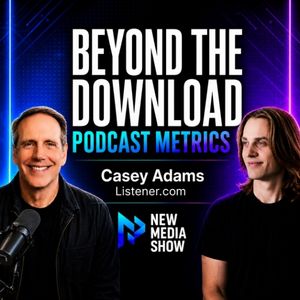
Podcasting Beyond the Download | Casey Adams, Listener.com #673

New Media Show with Host, Rob Greenlee with #673 Guest Casey Adams, Lisener.comIn Episode 673 of the New Media Show, host 2017 Podcast Hall of Famer Rob Greenlee welcomes Casey Adams, founder and CEO of Listener.com and host of The Casey Adams Show, for a timely conversation about how podcasting, video, social content, advertising, and new media measurement are rapidly converging.
For more than 20 years, podcasting has relied heavily on RSS feeds, downloads, and audio-first measurement as the foundation of distribution and advertising value. That still matters, but the media environment around it has changed dramatically.

Shows now are distributed across Apple Podcasts, Spotify, YouTube, social video, newsletters, clips, livestreams, and direct audience communities. Audiences may call it all a podcast, even as the industry continues to debate its technical definition.

Casey brings a founder, creator, and investor perspective to the discussion. He started podcasting as a teenager, interviewing founders and entrepreneurs, and later built MediaKits.com before moving into podcast analytics with Listener.com. His current work focuses on helping modern publishers understand how a single episode performs across audio, long-form video, short-form clips, newsletters, and social platforms.

Rob and Casey explore why the term “podcast” now means different things to different groups. To many longtime industry professionals, podcasting still points back to RSS-based audio distribution. To many younger listeners and viewers, it means a format: a recurring show, often conversational, often video-enabled, and consumed wherever attention already exists.

The conversation centers on one of the biggest questions facing podcasting and new media right now:

How do you measure the true value of a show when the audience is no longer in one place?

Rob and Casey also discuss why the download can no longer carry the entire weight of podcast measurement.

A single episode may now generate value through an Apple Podcasts listen, a Spotify stream, a full YouTube view, a YouTube Short, a TikTok clip, a LinkedIn post, an X post, a newsletter mention, and a brand integration that travels across all of those surfaces. Each platform counts activity differently. Each platform has its own audience behavior. That makes reporting, sponsorship value, and campaign analysis more complex.

Casey explains Listener.com’s concept of episode clusters: grouping the full set of related content around one episode so publishers and advertisers can see the larger cross-platform reach and performance.

Instead of treating the audio file as the entire campaign, an episode cluster recognizes that one conversation can become long-form video, social clips, newsletter content, and multiple ad touchpoints.

We also discuss the rising influence of creator-led media companies. Examples like TBPN, Jomboy Media, Substack’s media activity, and venture-backed new media brands show how independent shows and creator-driven networks are increasingly competing with legacy media for attention, trust, and advertiser value.

The conversation explores why companies, CEOs, investors, and major brands now seek to control their own narrative through podcasts, owned shows, and trusted media relationships.

We also examine the advertising side of this shift. Brands want better campaign reporting, but they also want context. A host-read placement, a social clip, a full video episode, and a newsletter mention should not all be treated the same.

Modern publishers need tools that let them demonstrate the full value of their media ecosystem without flattening every metric into a single misleading number.

Meaning for creators. Being a podcaster may no longer fully describe the work involved. Modern show builders are becoming media operators. They need to understand production, audience behavior, platform distribution, brand positioning, analytics, content packaging, and trust. The technical meaning of podcasting still matters, but the audience meaning matters just as much now.

For creators, networks, agencies, and brands, Episode 673 offers a clear look at the next stage of podcasting: a media business built around trusted shows, distributed everywhere, measured more intelligently, and no longer limited to downloads.

Topics Covered in This Episode:

00:33 Why podcast measurement is changing
01:00 Moving beyond the download
01:44 RSS, streaming, and modern distribution challenges
02:42 Introducing Casey Adams of Listener.com
03:37 Casey Adams joins the show
04:17 What Listener.com is trying to solve
05:00 AI-powered analytics for modern podcast publishers
05:41 Casey’s podcasting origin story
06:30 Interviewing Larry King and learning from media legends
07:18 Larry King’s warning about rejecting new media trends
08:04 From MediaKits.com to Listener.com
09:15 Rob’s early podcasting and radio background
10:04 Why the industry struggles with change
11:00 Does Casey still consider himself a podcaster?
12:00 Podcasts as a format, not just a technology
13:10 YouTube, Spotify, and the expanded podcast ecosystem
14:34 Why modern shows must meet audiences where they are
15:37 The audience now defines what a podcast means
16:16 RSS audio vs the broader podcast perception
17:16 Apple HLS and the pressure on RSS
18:17 The industry needs to accept broader podcast usage
19:26 Younger audiences and podcast consumption habits
20:39 Larry King’s quote behind Listener.com
21:25 Why RSS is becoming less visible to creators and audiences
23:21 Respecting podcasting’s roots while accepting change
24:00 The Uber analogy for podcasting’s disruption
25:41 Journalists, creators, and independent media companies
27:49 Creator-led media and the rise of new media brands
28:33 Legacy media relevance is being challenged
30:13 TBPN and the new media company model
31:28 Treating a show like a full media ecosystem
32:36 Year-long sponsorships and category exclusivity
33:49 Why serious creators must think like media companies
35:19 How podcast analytics supports advertiser relationships
36:00 Silicon Valley’s renewed interest in “new media”
37:23 The pandemic pushed legacy media into creator workflows
38:16 Casey introduces the Listener.com platform
39:05 Jomboy Media and creator-led sports coverage
40:00 Episode clusters and cross-platform performance
41:00 Tracking long-form video, audio, and short-form clips
42:18 Episode reports for brands and publishers
43:05 Why every platform metric should be valued differently
44:00 How Listener.com supports campaign reporting
45:00 Aggregating metrics from multiple platforms
46:00 Audio, content, commerce, and newsletter integrations
47:00 Using AI to match clips to episodes
48:00 Listener AI and talking to your podcast data
49:23 Making podcast data easier to understand and share
50:00 Where podcast analytics and AI go next
51:28 AI can guide creators, but execution still wins
52:23 Using AI as a thought partner for content strategy
53:24 Why creators must keep improving their shows
54:47 What drives new media inspiration today?
56:01 Why companies want to control their narrative
57:15 CEOs, podcasts, and trusted long-form conversations
58:22 Substack, owned media, and creator platforms
59:21 New podcast metrics standards and platform conflicts
1:00:35 How different platforms count views and plays
1:02:16 Serving publishers while tracking industry standards
1:03:00 Why brands need better cross-platform campaign reports
1:04:28 Toward better host-read campaign reporting
1:05:14 How platform changes flow into Listener.com data
1:06:00 Why publishers should control their own data
1:07:00 Putting a show’s full value forward
1:08:03 Brand, trust, and modern podcast IP
1:09:34 OpenAI, TBPN, and strategic media investment
1:10:32 Why TBPN brought sponsors back
1:11:11 How media brands can help shift company narratives
1:12:15 New media as a strategic communications layer
1:14:00 Lessons from AI-generated podcast network messaging
1:14:46 The risk of platform influence after acquisition
1:16:00 Why the TBPN deal was more than a podcast deal
1:16:39 Will more companies buy or build media brands?
1:17:40 HubSpot, distribution, and trusted voices
1:18:08 Why creators must stay honest with audiences
1:19:40 Authenticity and audience trust in sponsorships
1:20:05 Casey’s closing thoughts on podcasting and new media
1:20:34 Rob’s closing view on podcasting as one lane in new media
1:21:41 How publishers can work with Listener.com
1:22:43 Networks, independent shows, and Listener.com’s go-to-market
1:23:56 Closing remarks and where to find the show

Guest Links: Casey Adams, Founder and CEO, Listener.com

Listener.com: https://listener.com
Casey Adams Show & Website: https://www.caseyadams.com
The Casey Adams Show on Apple Podcasts: https://podcasts.apple.com/us/podcast/the-casey-adams-show/id1328795944
Casey Adams on LinkedIn: https://www.linkedin.com/in/casey-adams-430b3114a/
Casey Adams on X: https://x.com/CaseyAdams
Casey Adams on Instagram: https://www.instagram.com/casey/

Host: Rob Greenlee and New Media Show Links

Rob Greenlee Website: https://robgreenlee.com
New Media Show: https://newmediashow.com
New Media Show Audio on Apple Podcasts: https://podcasts.apple.com/us/podcast/new-media-show-audio/id392545649
New Media Show on YouTube: https://youtube.com/@TheNewMediaShow
Rob Greenlee on YouTube: https://youtube.com/@RobGreenlee
Podcast Hall of Fame: https://podcasthall.com

Personal / AI Disclosure Note

I used AI tools to help organize and edit this episode description and generate show notes from the episode transcript. The views, clarifications, responsibility, and industry perspective are mine and my guest’s. This article reflects my editorial direction and the substance of the conversation.

Can Creator Economy Build a Better Podcasting? | Sam Sethi, TrueFans #671

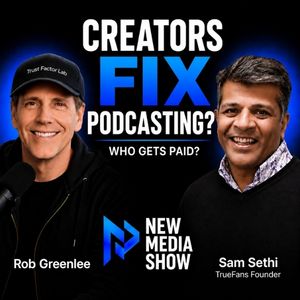
New Media Show with Rob Greenlee and Guest Sam Sethi of TruFansIn this episode of The New Media Show, host 2017 Podcast Hall of Famer Rob Greenlee welcomes Sam Sethi, founder of TrueFans and co-host of the Podnews Weekly Review.
They had a wide-ranging conversation about the future of podcasting inside the larger creator economy.

Podcasting helped create the independent creator movement through RSS, niche audiences, direct publishing, and long-form content that builds audience trust.

Today’s creators are building broader businesses around video, memberships, newsletters, live events, merchandise, premium content, clips, community, and direct fan relationships.

So, can the creator economy help build a better, more sustainable podcasting industry?

Rob and Sam explore why podcasting can no longer think only in terms of feeds, files, downloads, and ad impressions. They discuss the rise of creator portals, the importance of owning the relationship with audiences, and how platforms such as Patreon, Substack, Beehiiv, YouTube, Spotify, and Apple are changing creator expectations.

The conversation also examines whether advertising is becoming less central to the creator business model, and how subscriptions, premium content, micropayments, stablecoins, and value-for-value models could create new ways to share revenue among creators, listening apps, platforms, and even audiences.

Sam shares his perspective on HLS streaming, watch time and listen time analytics, activity streams, super fans, publisher feeds, and “super feeds” that can connect audio, video, events, merchandise, blogs, and community into a more portable, creator-owned media presence.

Rob and Sam also dig into the impact of AI on podcasting: AI-generated shows, human engagement as a discovery signal, AI bots scraping media, the rising need for clear content licensing, and the tension between making content available to AI discovery systems while protecting creator rights and value.

This episode is a deep look at where open RSS, creator ownership, platform control, AI discovery, video, monetization, and audience relationships may be heading next.

Topics covered in this episode include:

• The evolution of podcasting into a broader creator-led media business
• Why creators need direct relationships with fans, not just platform reach
Creator portals – memberships, newsletters, live events, merchandise, and premium content
Whether ad-supported podcasting is becoming less important
HLS streaming, listen-time and watch-time measurement, and better advertising accountability
Micropayments, value-for-value, stablecoins, and new revenue-sharing models
Activity streams, super fans, community engagement, and audience signals
AI-generated podcasts, discovery, AI bots, and licensing creator content
Publisher feeds, super feeds, playlists, and collective buying power for independent creators
Open RSS, data portability, proprietary platforms, and the future of media distribution

The New Media Show is a human-hosted and guested conversation about the future of creator-led digital media, including podcasting, video, live streaming, AI, audience trust, discovery, monetization, platforms, and the changing relationship between creators and their communities.

Watch the video and audio editions below and on YouTube; listen to the audio edition in your favorite podcast app; watch the video edition in Apple Podcasts; and visit NewMediaShow.com and RobGreenlee.com for more episodes and industry conversations.

Guest Links: Sam Sethi, Founder/CEO, TrueFans

TrueFans: https://truefans.fm
Sam Sethi on LinkedIn: https://uk.linkedin.com/in/samsethi
Sam Sethi on TrueFans: https://truefans.fm/fans/sam
Podnews Weekly Review: https://weekly.podnews.net
Sam Sethi on Podnews Weekly Review: https://weekly.podnews.net/1538779/contributors/411-sam-sethi

Rob Greenlee and New Media Show Links

Rob Greenlee Website: https://robgreenlee.com/
New Media Show: https://newmediashow.com/
New Media Show Audio on Apple Podcasts: https://podcasts.apple.com/us/podcast/new-media-show-audio/id392545649
New Media Show on YouTube: https://youtube.com/@TheNewMediaShow
Rob Greenlee on YouTube: https://youtube.com/@RobGreenlee
Podcast Hall of Fame: https://podcasthall.com/

About the Host/Author:
Rob Greenlee is a 2017 Podcast Hall of Fame inductee and Chair, a global new-media leader who bridges podcasting’s human roots and its AI-driven future. As founder of Trust Factor Lab and host of the New Media Show and Spoken Human, Rob helps creators start, grow, monetize, and future-proof their content. He has held leadership roles at Microsoft, Spreaker, Libsyn, StreamYard, Podbean, and PodcastOne, and serves as Chairperson of the Podcast Hall of Fame.

Personal / AI Disclosure Note:
I used AI tools to help organize and edit this video, episode description, and generate show notes from the episode transcript. The views, clarifications, responsibility, and industry perspective are mine and my guest’s. I have been working in podcasting, digital media, and platform adoption for more than two decades, and this article reflects my own position and editorial direction.

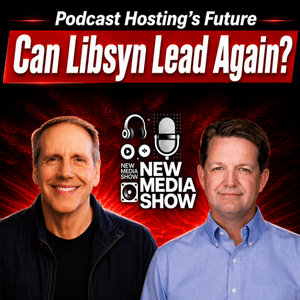
Libsyn’s Next Chapter: Podcast Hosting, Video, Monetization, RSS and API | Brendan Monaghan #660

“Podcast episode hosting used to be simple. You uploaded an audio file, generated an RSS feed, and distributed your show everywhere. That model still matters, but it is no longer enough for the modern creator economy.”

In this Episode 660 of The Live New Media Show, from April 22nd, 2026, Host Podcast Hall of Famer and Former Libsyn VP Rob Greenlee shares a screen and microphone with Brendan Monaghan, President and CEO of Libsyn, to explore how podcast hosting is changing and what creators should expect from platforms in 2026 and beyond.

This conversation gets to the heart of a major shift happening across podcasting and new media.

Hosting companies are no longer judged only by whether they can deliver a clean RSS feed and reliable file storage. Creators now expect monetization, analytics, video support, workflow efficiency, AI-assisted publishing, broader distribution, and real help with audience growth.

That larger shift frames the entire discussion between Rob and Brendan.

Brendan explains that Libsyn still carries the legacy of being one of podcasting’s earliest and most important hosting platforms, but the company is now operating in a far more complex environment.

Brendan points to Libsyn’s evolution from a technology-led hosting company into a broader creator platform that includes advertising and monetization infrastructure, especially after the company acquired businesses such as AdvertiseCast and Pair Networks. He argues that the modern hosting business must combine publishing, monetization, measurement, and simplicity for creators at every stage of growth.

Rob pushes the conversation further by asking the bigger industry question:

What should a podcast hosting company become now? That leads into a wide-ranging discussion about platform aggregation, creator workflows, newsletters, live events, merchandise, and the growing expectation that creators should be able to manage more of their media business from one place. Brendan makes the case that the future belongs to companies that can keep creators at the center while simplifying the growing complexity around distribution and monetization.

A major part of the episode focuses on AI.

Brendan breaks AI into three areas: how Libsyn uses it internally as a business, how AI can assist creators with production and publishing workflows, and how fully AI-generated content may affect the medium’s future.

Rob adds a deeper perspective by arguing that AI podcasting is already becoming more competitive than many in the industry want to admit. The two discuss whether the market will ultimately decide what AI content succeeds, why “AI slop” may be too broad a label, and why trust and disclosure may become much more important as synthetic media becomes harder to distinguish from human-created work.

The episode also dives into one of the most important strategic tensions in podcasting right now: RSS versus API publishing.

Rob and Brendan both acknowledge that most creators care more about simple distribution than the underlying protocol, but they also recognize that this shift has major implications for openness, platform control, and long-term creator independence.

Their exchange about Apple, Spotify, YouTube, and the shift toward more controlled video delivery models reflects a broader market reality: creators increasingly want to be everywhere, but the mechanics of getting there are becoming more fragmented and platform-specific.

Another strong section of the conversation centers on video.

Brendan says Libsyn intends to be a leader in video, while Rob raises a practical concern many creators are just beginning to feel: a show that works well on YouTube may not automatically translate well to an audio-first experience, and a show built for traditional audio may not fully satisfy video-driven discovery environments. That raises the possibility that creators will need to think more deliberately about format, audience expectations, and whether a single production workflow can truly serve all platforms equally well.

The conversation becomes especially valuable when the two discuss metrics:

Apple’s HLS direction, and what streaming-style delivery might mean for podcast measurement and advertising. They point to a future in which the industry may move closer to actual listening signals rather than relying so heavily on download-based assumptions. If that happens, it could affect CPMs, ad sales, programmatic video advertising, and the broader economics of the medium.

Rob also frames one of the biggest unresolved questions in new media today:

If AI-generated shows become easier, faster, and more polished, what will human creators need to do to remain distinct and trusted?

The answer that emerges from this episode is not panic. It is focus, transparency, stronger format thinking, and a deeper commitment to serving audiences with clarity and value. That makes this episode less about Libsyn alone and more about the future structure of podcasting itself.

Topic Chapters and Timestamps
00:00 Podcast hosting is no longer simple
01:00 What creators now expect from hosting platforms
02:00 Brendan Monaghan introduction and background
03:00 Why Libsyn’s legacy still matters
05:00 Hosting, publishing, monetization, and measurement
07:00 How Libsyn expanded its monetization business
08:00 Why creators should not need to leave Libsyn to scale
09:00 How monetization changed podcasting
10:00 Lowering barriers for creators to earn revenue
12:00 What the future hosting platform should become
13:00 Newsletters, live events, merchandise, and creator tools
15:00 AI and creator workflows
16:00 Brendan’s three-bucket view of AI
18:00 AI-generated content and the “AI slop” debate
20:00 Why the market may decide what AI content wins
23:00 RSS versus API publishing
25:00 Simplicity and multi-platform distribution
26:00 Why RSS matters less to end users now
28:00 Open versus closed ecosystems
29:00 RSS innovation and slow adoption
31:00 Apple HLS and changing audio-video delivery
32:00 Platform control and the walled garden debate
41:00 Measurement, streaming, and actual listening data
43:00 Programmatic video ads and creative formats
45:00 Why video creators may need to think more like audio creators
47:00 Can AI help bridge the gap between formats?
49:00 Audio loyalty versus video momentum
50:00 The growing pressure on creators to win everywhere
51:00 AI Algorithms, the first audience for human content
53:00 Are AI-generated shows driving growth?
55:00 AI clone content and rising competition for humans
56:00 Why AI labeling may become essential
59:00 What Libsyn will focus on over the next 24 months
01:01:00 Audio, video, audience growth, and execution
01:03:00 Staying focused on core creator needs
01:05:00 Closing thoughts

This episode answers key industry questions that creators, executives, and media strategists are increasingly asking:
-What is Libsyn doing next under Brendan Monaghan?
-How is podcast hosting changing in 2026?
-Will video become a required part of podcast distribution?
-What does Apple’s HLS move mean for audio and video podcasting?
-Is RSS still the future, or are APIs taking over?
-How will AI-generated content affect podcasting, trust, and monetization?
-What should creators expect from modern hosting platforms now?
-Those questions are directly addressed in this discussion, making this episode highly relevant to search, social discovery, AI answer engines, and recommendation surfaces.

Guest and Show Links
Brendan Monaghan, CEO of Libsyn
https://Libsyn.com

Host Rob Greenlee and Show Links
New Media Show: https://newmediashow.com/
Rob Greenlee: https://robgreenlee.com/
Trust Factor Lab: https://trustfactorlab.com/
Adore Creator Network: https://adorenetwork.com/
Podcast Hall of Fame: https://podcasthall.com/
Rob Greenlee YouTube: https://youtube.com/@robgreenlee
Rob Greenlee LinkedIn: https://linkedin.com/in/robgreenlee
Rob Greenlee Instagram: https://instagram.com/robwgreenlee