Remembering Todd Cochrane, One Year Later

One year ago today, on September 8, 2025, we lost Todd Cochrane.
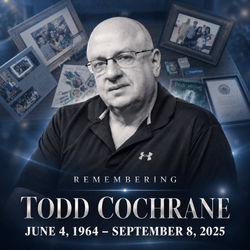
Todd Cochrane RIP 2025Todd was my longtime co-host on the New Media Show, a podcast builder from the medium’s earliest days, and one of its strongest advocates for independent creators, open RSS, ownership, and direct connection with audiences.

Looking back on these conversations, what stands out most is how consistently Todd fought for what he believed mattered. He never forgot why podcasting was different in the first place: it removed barriers, gave creators more control, and made it possible to build real communities without asking gatekeepers for permission.

He also understood that none of it came easy. Todd often talked about “sweat equity,” doing the work, building something from the ground up, and earning an audience’s trust over time. That was who he was.

What makes this video especially difficult to watch is the ending. In what became his final New Media Show appearance, Todd signed off the way he always did, expecting there would be another episode:

“We’ll see you next time.”

I wish there had been a next time.

Todd’s voice, his ideas, and the impact he had on podcasting are still very much part of the conversation.

Remembering my friend and New Media Show co-host Todd Cochrane today.

June 4, 1964 – September 8, 2025

More remembrances of Todd Cochrane:

New Media Show: Remembering Todd Cochrane, Podcast Hall of Famer and Blubrry CEO

A special New Media Show episode with Adam Curry, Mike Dell, Rob Walch, and me remembering Todd’s life, personality, career, advocacy for independent podcasting, and his impact on the medium.

New Media Show remembrance
https://newmediashow.com/2025/09/

Podnews: Obituary: Todd Cochrane

James Cridland and I worked together on this obituary covering Todd’s life, Navy career, Geek News Central, Blubrry, open RSS advocacy, the Podcast Awards, New Media Show, and his wider impact on podcasting.

Read the Podnews obituary: 
https://podnews.net/article/todd-cochrane-obituary

Blubrry Podcasting: Blubrry Founder Todd Cochrane: In Memoriam

The company Todd founded remembered him as the heart of the Blubrry community and said it is committed to continuing his mission of supporting podcasters and independent creators.

Read Blubrry’s remembrance
https://blubrry.com/podcast-insider/2025/09/09/blubrry-founder-todd-cochrane-in-memoriam/

Geek News Central: Geek News Central Mourns the Loss of Todd Cochrane

Todd’s longtime show and publication remembered its founder, host, and driving force, as well as his impact on technology, podcasting, and the people around him.

Read the Geek News Central remembrance
https://geeknewscentral.com/2025/09/09/geek-news-central-mourns-the-loss-of-todd-cochrane/

Podcast Movement: In Memory of Todd Cochrane

Dan Franks reflected on Todd’s early support of Podcast Movement, his willingness to challenge the industry, and his commitment to independent podcasters.

Read the Podcast Movement tribute: 
https://weekly.podcastmovement.com/p/in-memory-of-todd-cochrane

Sounds Profitable: Remembering Todd Cochrane

Tom Webster shared a personal remembrance of Todd, including how Geek News Central was the first podcast he listened to nearly two decades earlier and how Todd’s belief in creators shaped both his work and his business.

Read Tom Webster’s remembrance: 
https://soundsprofitable.com/article/remembering-todd-cochrane/

Podnews Weekly Review: Remembering Todd Cochrane

James Cridland and Sam Sethi looked back on Todd’s career and included material from an earlier conversation with him about how he began podcasting in 2004 and what the medium meant to him.

Listen to the Podnews Weekly Review remembrance: 
https://weekly.podnews.net/1538779/episodes/17833228-remembering-todd-cochrane-and-apple-testing-new-chapters

PodBiz: When Independent Voices Shape an Industry: Remembering Todd Cochrane

Recorded before Todd’s passing, this conversation captures him in his own words as he discusses monetization, independent creators, audience trust, and why serving listeners has to come before chasing revenue.

Listen to the PodBiz episode
https://shows.acast.com/podbiz/episodes/remembering-todd-cochrane

podCast411: Todd Cochrane Interview from March 2005 Remastered

Rob Walch remastered his original March 2005 interview with Todd, offering a rare chance to hear Todd near the very beginning of the podcasting era.

Listen to the remastered 2005 interview
https://www.iheart.com/podcast/263-podcast411-learn-about-pod-27564388/episode/411-item-0022b-todd-cochrane-294330497/

podCast411: Memorial to Todd Cochrane on New Media Show

Rob Walch also shared the New Media Show memorial conversation with his podCast411 audience.

Listen to the podCast411 memorial feed drop
https://www.iheart.com/podcast/263-podcast411-learn-about-pod-27564388/episode/memorial-to-todd-cochrane-on-new-294330496/

Podcaster News: Remembering Site Founder Todd Cochrane

The site Todd founded remembered his drive, fearlessness, generosity, and desire to help other people succeed.

Todd Robert Cochrane obituary

Todd’s family obituary provides the personal record of his life, including his Michigan roots, 22 years of Navy service, family, technology interests, and the people he left behind.

Read Todd’s obituary: 
https://www.tributearchive.com/obituaries/45326462/todd-robert-cochrane

The New Media Show continues today with Todd very much a part of its foundation. The conversations have changed, the industry continues to evolve, and there are still plenty of things I know Todd and I would be debating.

I still miss having him on the other side of that conversation.


Why “Fringe” Was the Wrong Word and What I Actually Meant About Podcasting 2.0

By Rob Greenlee
New Media Show with Rob Greenlee - NewMediaShow.comThis article provides context about my comments on New Media Show episode 660 with Libsyn CEO Brendan Monaghan, where we discussed Podcasting 2.0, RSS tag adoption, and the gap between innovation and mainstream platform implementation.
During my recent interview conversation with the Libsyn CEO, I used the word “fringe” when discussing Podcasting 2.0 RSS extension tag ideas. That comment in an extended audio clip was played and discussed on “Podnews Weekly Review“, and understandably, it raised concerns in parts of the podcasting 2.0 community, including Dave Jones and Adam Curry on the Podcasting 2.0 podcast.  Let me say this clearly. That was not the right word for me to use, and I regret saying it that way. Not because I am backing away from the broader point I was trying to make, but because the word itself does not reflect how I actually view the work happening in the Podcasting 2.0 and open RSS ecosystem.
The comment came out quickly in a live discussion and did not carry the full context I intended.
What I was trying to describe is something I have repeatedly seen said over the past two decades working with large platforms, hosting companies, and media organizations: there is a real difference between something that is not widely adopted yet and something that is not valuable.
Podcasting 2.0 Innovation Has Real Value
Podcasting 2.0 innovations are valuable. RSS namespace expansion, new tags, and experimentation around monetization, identity, transcripts, funding, and distribution all matter. This is where much of the real innovation in podcasting is happening.
At the same time, many of these capabilities have been around for several years, in some cases for close to five years. That historical context matters. My comment was not about the value of the ideas themselves. It was about the pace and pattern of adoption, especially among larger platforms.
When I used the word “fringe,” I was referring to the broader set of emerging and evolving tag ideas within the Podcasting 2.0 initiative.
There are many tags and concepts at different stages of maturity, market fit, timing, and implementation. Not all of them have broad agreement or adoption, even within standards-focused efforts like the Podcast Standards Project. From a product and platform perspective, this creates a spectrum of adoption rather than one unified standard that everyone has fully embraced.
What I Was Trying to Say
What I meant is that market fit and timing play a major role in what gets adopted at scale. Larger podcasting platforms tend to move more deliberately. Their decisions are shaped by user experience, engineering resources, monetization models, product stability, support complexity, and business priorities.
That often means only a subset of new capabilities gets integrated into mainstream products at any given time. That has been the pattern over the past several years. But it is also important to say this pattern is changing.
Momentum Started Very Slow, But Is Building
Over the past year or so, we have started to see real momentum around some Podcasting 2.0 tags and capabilities. More platforms are experimenting. More tools are supporting them. More creators are becoming aware of what is possible and how these features can be used in real workflows.
That has been great to see
I believe we will continue to see more adoption of certain RSS tags as platforms, tools, and creators find clearer ways to integrate them into everyday use.
Some Tags Are Seeing More Adoption
You can already see this progression in parts of the ecosystem.
Tags like transcript, chapters, and person have seen meaningful adoption because they provide immediate and understandable value. The Alternative Enclosure tag is being more widely adopted across platforms, too. They improve accessibility, discovery, context, and creator attribution.  The funding tag has gained traction within parts of the ecosystem, especially among creators and platforms exploring alternative monetization models. The value tag, which supports value-for-value and streaming payment models, has been adopted within specific apps and communities, though it has struggled more recently and has not yet become mainstream across larger platforms. Other tags and ideas are still at an earlier stage. Some are being tested. Some are evolving. Some are still looking for the right use case that will drive broader adoption. That is what I meant by a spectrum of innovation.
Innovation and Adoption Are Not the Same Thing
Podcasting operates across two layers simultaneously. 
There is an innovation layer, where developers, independent platforms, and forward-thinking creators create and test new ideas. Then there is a platform layer, where those ideas are evaluated, prioritized, supported, and integrated into products used by millions of people.  The gap between those two layers is where much of the tension comes from.
I have seen this pattern many times. Podcasting itself began outside the mainstream.
Mobile listening took time to become the default. Video podcasting has gone through multiple cycles before finding its current role. Programmatic advertising in audio took years to mature.  Innovation usually moves faster than adoption. Adoption follows when user demand, product fit, creator benefit, and business alignment come together.
That is where many Podcasting 2.0 capabilities have been.
My View of Podcasting 2.0 and the Podcast Standards Project
I also want to be clear that Podcasting 2.0 and the Podcast Standards Project are not the same thing. They overlap in some areas, but they do not necessarily embrace every tag or idea in the same way.
That is part of the larger point.
When standards-oriented efforts evaluate which capabilities to support, it shows that this is not simply a question of innovation versus resistance. It is about maturity, usefulness, interoperability, timing, and market fit.  That is the context I was trying to convey, though I did not do so well at the time.
I Respect the Podcasting 2.0 Community
So when I used the word “fringe,” I was trying to describe how some organizations have historically perceived ideas that had not yet reached scale or product integration. But I understand how that word sounded dismissive of Podcasting 2.0, and that is not how I really see it.

I respect and appreciate the innovation and work happening through PodcastIndex.org, Podcasting 2.0, and the broader open podcasting community, including the work and advocacy of Adam Curry, Dave Jones, Daniel J. Lewis, and many others.

The opportunity now is to build on the momentum emerging and move the most valuable ideas toward broader adoption. That means making these capabilities easier to use, improving listener experiences, aligning them with sustainable business models, and demonstrating clear value at scale. That is how innovation moves from experimentation into everyday use.
My Role in the Conversation
I do not want to frame this as one side versus another. I am focused on helping connect what is being built with what is actually being adopted and used at scale.
That is the conversation we are having every week on the “New Media Show“. Join us LIVE on Weds, 3 pm PST/6 pm EST, or on demand in all the podcast apps and live on YouTube.com/@robgreenlee, LinkedIn.com, Facebook.com, and X.com
So, yes, I regret the word “Fringe” I used.  But I stand by the broader point that there has been a gap between innovation and adoption in podcasting over the past several years. The good news is that momentum is building, and that gap is starting to close.  That is where the real opportunity is for all of us in this industry.

About the Author
Rob Greenlee is a 2017 Podcast Hall of Fame inductee and Chair, a global new media leader who bridges podcasting’s human roots with its AI-driven future. As founder of Trust Factor Lab and host of the “New Media Show” and “Spoken Human”, Rob helps creators start, grow, monetize, and future-proof their content. He’s held leadership roles at Microsoft, Spreaker, Libsyn, StreamYard, and PodcastOne, and serves as Chairperson of the Podcast Hall of Fame. Learn more at RobGreenlee.com and join the Trust Factor Lab Creator/Podcast Services.

Personal note: I used AI tools to help organize this article and hand-edited it; the views, clarifications, responsibility, and industry perspective are mine. I have been working in podcasting and platform adoption for more than two decades, and this article reflects my own position. The original word choice was mine, and so is the clarification.


Podcasting’s Multi-Format Future | Sharon Taylor #659

Podcasting is entering a new phase, and this episode goes straight into the infrastructure, business models, and platform shifts shaping what comes next.

On episode 659 of The New Media Show, Host and Podcast Hall of Famer Rob Greenlee shares the microphone with Sharon Taylor, Chief Revenue Officer at Triton Digital (Spreaker & Omny Studio), for a deep conversation about where the podcasting market is heading right now.

Sharon brings years of experience from Omny Studio, Triton Digital, and Spreaker, making her one of the best people to help unpack what is changing across hosting, monetization, video, AI, advertiser demand, and measurement.

We talk through why podcasting is not simply becoming video-first, even as video becomes a bigger part of how shows are discovered and monetized.

Sharon makes a strong case that audio remains at the center of the medium, but the future is clearly becoming more multi-format. That means creators, publishers, and platforms need to think differently about how they distribute content, measure audience behavior, and build sustainable business models for both audio and video.

A big part of this conversation focuses on Triton Digital’s role in the market today and why its combination of Omny Studio, Spreaker, and broader ad tech infrastructure makes it an important player in podcasting’s next chapter.

Sharon explains the unique roots of Omny Studio as a platform built for large-scale broadcast and enterprise publishing needs, while Spreaker helped pioneer early podcast programmatic monetization for creators. That combination gives Triton a unique perspective on both professional publishing and creator-driven growth.

We also spend time on Apple’s HLS video move and what it may mean for podcasting’s future. Sharon shares how Triton had already been preparing for a broader video environment and why Apple’s support for HLS is such a meaningful shift.

We discuss how HLS could improve flexibility around delivery, ad insertion, and measurement, while still raising important questions about RSS, open distribution, and whether major platforms may slowly pull podcasting into more platform-specific publishing models over time.

Another major topic in this episode is trust.

From programmatic advertising to AI-generated content to labeling and transparency, Sharon and I explore how podcasting can continue to grow without losing the authentic connection that made the medium valuable in the first place.

We both agree that podcasting still has enormous strength as an audio-led medium, but the industry is now balancing openness, innovation, and monetization in ways that will define the next few years.

This is a wide-ranging and important discussion for anyone watching the evolution of podcasting, video, ad tech, platform power, and the future of open media.

Topics covered

– Why Triton Digital matters in podcasting right now
– Sharon Taylor’s path from Omny Studio to Triton CRO
– What Triton is seeing in audio versus video audience behavior
– Why podcasting is becoming multi-format, not simply video-first
– How Omny Studio and Spreaker fit different parts of the publishing market
– What Apple’s HLS video move changes for publishers and hosting platforms
– Why advertiser confidence and better measurement matter more than ever
– The future of RSS, open podcasting, and platform fragmentation
– How AI-generated content is affecting publishing growth and industry trust
– Where Sharon sees the next big opportunities for podcast growth

Guest

Sharon Taylor is the Chief Revenue Officer at Triton Digital. She was appointed to the CRO role in August 2025 after helping lead Triton’s podcast and content delivery efforts. Before joining Triton, Sharon was CEO of Omny Studio and played a key role in building it into one of the leading enterprise podcast platforms before its acquisition by Triton Digital.

Triton Digital: https://www.tritondigital.com/
Spreaker: https://www.spreaker.com/
Omny Studio: https://omnystudio.com/

Host

Rob Greenlee is a 2017 Podcast Hall of Famer, Chairperson of the Podcast Hall of Fame, and leader behind Trust Factor Lab and Trust Creators Community at M3Linked.

New Media Show: https://newmediashow.com/
Rob Greenlee: https://robgreenlee.com/
Podcast Hall of Fame: https://podcasthall.com/
Trust Creators Community: https://m3linked.com/

Supporters:

Get a $10 StreamYard Video Recording and Live Streaming tool Discount using this LINK – https://streamyard.com/pal/c/5606177711325184

Podcasting pros use Podpage – Build a podcast or video show website that updates itself and showcases your show beautifully. Start for just $12/month! –>podpage.com?via=adore