Podcast: Play in new window | Download
Subscribe: Apple Podcasts | Android | Podcast Index | RSS
Podcast (audio): Play in new window | Download
Subscribe: Apple Podcasts | Spotify | Android | Podcast Index | RSS
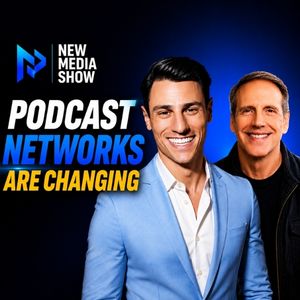 In episode 666 of the New Media Show, hosted by 2017 Podcast Hall of Famer Rob Greenlee, Rob talks with Greg Wasserman, Head of Relationships at RSS.com and host of Podcast Network Insights, for a deep conversation about one of the biggest questions facing podcasting, video, creator media, and digital networks right now:
Podcast networks were originally built for an audio-first industry, but audiences have already moved the definition of a podcast beyond audio. Today, a podcast can be a YouTube show, a Spotify video, an Apple video podcast, a livestream, a short clip, a newsletter, a community, or part of a larger creator-led media brand.
Greg brings a unique perspective from his work at RSS.com and from interviewing the leaders behind podcast networks, collectives, production companies, and niche media groups on Podcast Network Insights. He explains that podcast networks are no longer one simple model. Some are media-sales businesses. Some are community-driven groups. Some operate more like production companies, collectives, or full creator networks.
Rob and Greg explore how the network model is shifting as video, live streaming, AI, Apple Podcasts, HLS video, YouTube, Netflix, Spotify, FAST channels, private communities, and creator monetization reshape what podcasting can become.
The conversation also asks whether independent podcasters should join networks, what creators need to understand before making that decision, and why the future may depend less on downloads alone and more on trust, audience relationships, collaboration, niche value, and direct monetization.
00:00 Welcome to New Media Show #666
00:32 Are podcast networks becoming creator networks?
01:00 How audiences have already redefined podcasting
02:00 Introducing Greg Wasserman from RSS.com
03:00 Why Greg created Podcast Network Insights
04:00 How different podcast networks define community
05:00 Monetization, growth, and the changing role of networks
06:00 Internal network community vs audience community
07:00 Private communities, subscriptions, and audience relationships
08:00 Nova Podcast Network and media-company network models
09:00 Cross-promotion and collaboration inside networks
10:00 Are creators returning to collaboration?
11:00 Podcast networks as media companies
13:00 Owned-and-operated shows vs independent rev-share shows
15:00 Why ad revenue is not the only network business model
16:00 Marketing Podcast Network and niche value
17:00 Jay Shetty, Netflix, and platform exclusivity
18:00 Is Netflix becoming a podcast network?
19:00 Collectives, media companies, and different network definitions
20:00 What is a podcast network today?
21:00 Production companies and network partnerships
23:00 How creators should decide whether to join a network
24:00 Understanding your “why” before joining a network
25:00 iHeart, ad inventory, and the volume-based network model
26:00 Why sponsor status can distract from real monetization
27:00 Does network branding still matter?
28:00 Pineapple Street, GZM, Disney, and network identity
30:00 MCNs, YouTube networks, and the return of multi-channel networks
31:00 Silicon Valley, new media networks, and digital-native media
34:00 Traditional media adopts podcasting, video, and companion content
35:00 Apple Podcasts HLS video as a future distribution channel
36:00 Why video attracts higher media dollars
37:00 Know, like, and trust as a creator value
38:00 Will Apple Podcasts HLS video matter?
39:00 Free platforms, hidden costs, and creator control
41:00 Future ad dashboards across Spotify, Apple, YouTube, and Twitch
42:00 Platform exclusivity, Jay Shetty, Joe Rogan, and audience loss
44:00 Creator hustle and why networks cannot do all the work
46:00 Subscription fatigue and fragmented media access
47:00 More than 20 ways creators can make money
48:00 Lean creator teams, production help, and content scale
49:00 How podcast networks are using AI
50:00 AI-generated voices, sleep content, and audience behavior
52:00 AI for ads, scripts, show notes, social, and workflows
53:00 AI podcast networks and automated show creation
54:00 Agentic workflows and creator production systems
56:00 AI-generated content, humanity, and audience trust
57:00 Algorithms, AI interfaces, and future discovery
58:00 Platform algorithm changes and creator risk
59:00 Human connection, live events, and AI video podcasts
01:00:00 Why human storytelling still matters
01:01:00 Could creators build AI clones of themselves?
01:02:00 Avatars, HeyGen, Gemini, and disclosure
01:03:00 Human-hosted content labels and AI transparency
01:04:00 Video-first creators and separate audio/video feeds
01:05:00 Why The New Media Show still uses separate audio and video feeds
01:06:00 Audio-first creators, social media, and growth challenges
01:07:00 Different networks play different games
01:08:00 The future of compelling audio experiences
01:09:00 Spatial audio, AI audio, and interactive media
01:10:00 Personalized audience experiences and liquid content
01:11:00 Can audiences be moved from YouTube to Netflix?
01:12:00 Bundling, subscriptions, and platform experiments
01:15:00 Algorithms vs human curation
01:16:00 Netflix, FAST channels, and new distribution models
01:17:00 The technology challenge behind FAST channels
01:23:00 Greg’s Tesla and the future of in-car video podcast listening
01:24:00 RSS.com, Podcasting 2.0, and AI labeling standards
01:25:00 Closing thoughts and where podcasting is heading
Guest and Host Links
Guest: Greg Wasserman
Head of Relationships at RSS.com and host of Podcast Network Insights
- RSS.com: https://rss.com
- Greg Wasserman at RSS.com: https://rss.com/blog/greg-wasserman/
- Podcast Network Insights: https://rss.com/podcasts/podcast-network-insights/
- Greg Wasserman on LinkedIn: https://www.linkedin.com/in/gregwasserman
Host: Rob Greenlee
- New Media Show: https://newmediashow.com
- Rob Greenlee: https://robgreenlee.com
- Podcast Hall of Fame: https://podcasthall.com
- Rob Greenlee on LinkedIn: https://www.linkedin.com/in/robgreenlee
- Rob Greenlee Booking: https://calendly.com/robgreenlee
About the Host/Author:
Rob Greenlee is a 2017 Podcast Hall of Fame inductee and Chair, a global new-media leader who bridges podcasting’s human roots and its AI-driven future. As founder of Trust Factor Lab and host of the “New Media Show” and “Spoken Human”, Rob helps creators start, grow, monetize, and future-proof their content. He’s held leadership roles at Microsoft, Spreaker, Libsyn, StreamYard, and PodcastOne, and serves as Chairperson of the Podcast Hall of Fame. Learn more at RobGreenlee.com and join the Trust Factor Lab Creator/Podcast Services.
Personal/AI Disclosure Note: I used AI tools to help organize and edit this episode and generate show notes. I have made hand edits; the views, clarifications, responsibility, and industry perspective are mine and my guest’s. I have been working in podcasting and platform adoption for more than two decades, and this article reflects my own position.

 In this episode, we relaunch the New Media Show #643 with special guest Rob Walsh, VP of Libsyn.