Podcast: Play in new window | Download
Subscribe: Apple Podcasts | Android | Podcast Index | RSS
Podcast (audio): Play in new window | Download
Subscribe: Apple Podcasts | Spotify | Android | Podcast Index | RSS
When AI can make anything look polished, what earns an audience’s trust?
Watch episode 694 on YouTube ↗
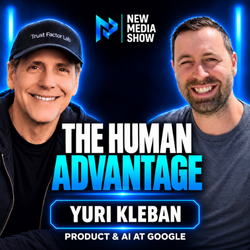 Can creators still build trust when AI can generate convincing voices, polished videos, personalized messages, and entire digital personalities? The harder question is what makes someone worth following when production quality becomes easier to reproduce.
In New Media Show #694, Rob Greenlee talks with Yuri Kleban, introduced as a Global Product Lead Manager in Partnerships at Google, about the human contribution to AI-assisted media. They explore originality, disclosure, storytelling, creative judgment, and the relationship between creators and audiences.
The conversation moves from Yuri’s experiment with a disclosed workplace bot to AI-assisted games, fan-created entertainment, and the practical limits of automation. Both speakers see creative opportunities, while examining permission, impersonation, workload, and the risk of handing over too much judgment. Their predictions and examples reflect the discussion, not announcements of Google or YouTube products or policies.
The central question: if AI can handle more of the production, what should the human creator remain responsible for?
Three practical takeaways
- Make the audience’s problem your starting point. Rob and Yuri return to usefulness, a distinctive point of view, and storytelling. Choose an idea that helps a specific audience before deciding which AI tools or production techniques to use.
- Keep a person accountable for the result. Review AI-assisted work for accuracy, meaning, permission, and disclosure. Yuri describes a process of generating possibilities, choosing what works, and refining it. The first output is a starting point for judgment.
- Measure the whole workload. Faster production can lead to more projects and more supervision. When testing an AI workflow, count reviewing and correcting time as well as generation time, and set a limit on how much new work you take on.
Why polish is becoming a weaker signal
Yuri recalls the effort he once put into making his own video work look polished. He argues that when tools make professional-looking production widely available, polish alone becomes less useful as evidence of a creator’s effort or originality.
That shifts attention toward the idea, the story, and the perspective behind the work. Rob connects this to human intuition: the choices a creator makes about what matters to other people. AI may help execute an idea, but the discussion keeps returning to the human who decides what is worth making and why.
For podcasters and video creators, the practical implication is to explain something clearly, bring experience to the conversation, and make editorial choices an audience can recognize. Better tools can support that work; production quality by itself does not establish credibility.
The disclosed bot that did not sound like Yuri
One of the episode’s most revealing examples comes from Yuri’s workplace. He describes building a bot that answers colleagues’ questions using his knowledge. The bot is identified as a bot, but some colleagues tell him that its responses do not sound like him.
Yuri experiments with familiar features of his own writing, including imperfect spelling and punctuation. He does not report a proven improvement in trust; he is still exploring the outcome. The example raises a useful distinction between a recognizable communication style and evidence that an answer is reliable.
An editorial suggestion: if you use an assistant to represent your expertise, make its role clear and give people a way to reach the responsible human. Familiar phrasing can make communication easier to recognize, but it should not substitute for disclosure or checking an answer.
Human, AI, and hybrid media can serve different audiences
Rob and Yuri consider a future with human-created, AI-generated, and hybrid entertainment. Yuri expects different audiences to value different experiences. Human unpredictability, personal history, and relationships may remain important even when synthetic media becomes more capable.
The conversation also challenges the idea that all AI-assisted work belongs in one category. Yuri emphasizes whether something is interesting, useful, and distinctive. Rob brings the discussion back to the purpose and experience behind the content. Their views argue for audience value, not evidence that any particular format will succeed.
Fan-created episodes need permission and clear boundaries
Could audiences create alternative endings or new episodes featuring familiar performers and fictional worlds? Rob and Yuri explore that possibility as a future creative model. Yuri’s version includes permission, clear labeling, limits set by the original participants, and compensation for the people whose work or identity is being used.
These are proposals discussed in the episode, not a claim that creators already have permission to reuse someone’s voice, likeness, or characters. The important question for a media business is who can authorize the use, what they have agreed to, and how an audience will understand what it is watching.
That distinction matters to trust. A clearly identified creative extension and an impersonation presented as the real person create very different expectations.
AI can expand creative participation
Yuri describes building a custom game with his children, combining their ideas with AI-assisted development. The example illustrates a broader theme: tools can let people try ideas they would otherwise struggle to produce, while human direction and iteration still shape the result.
He also describes asking for multiple possibilities when developing creative material, then selecting and refining them. Rob connects that approach to his experience building websites and production workflows. Both describe collaboration with tools, rather than a finished creative product emerging without review.
The productivity paradox: faster tools, more work
Rob’s experience with AI is that it can make him busier. As production becomes easier, he takes on more projects, each of which still needs attention and decisions. Yuri suggests that people may need time to develop healthier limits around tools that keep expanding what feels possible.
For an independent creator, more output is not automatically a better business outcome. A workflow can save time on one task while adding review, coordination, or maintenance elsewhere. The episode invites creators to decide what they want to do with the saved time before filling it with another project.
Optimism with room for disagreement
Yuri is optimistic about wider access to creative tools, but he also acknowledges fears about work, misuse, and impersonation. He describes fraudulent attempts to use a copied voice as an example of how the technology can erode trust.
Rob and Yuri discuss possible futures for employment and media, without resolving how quickly those changes will arrive. They emphasize learning how the tools work, weighing benefits and risks, and keeping human responsibility central. Specific scenarios in the conversation are forecasts and thought experiments, not guaranteed outcomes.
One practical next step
Choose one small task in your next episode workflow, such as organizing research or drafting a description. Write down how long your usual process takes. Try an AI-assisted version, review it for accuracy, meaning, and appropriate disclosure, and include correction time in the comparison. Decide whether the result serves your audience better before expanding the experiment.
About Yuri Kleban
Yuri Kleban works at Google and is introduced in this episode as a Global Product Lead Manager in Partnerships. He brings experience across products, cloud, advertising, and partnerships to a discussion about AI and human creativity. The conversation includes his own experiments, observations, and predictions.
Episode transcript
Read the complete episode 694 transcript (text) · Download the timed transcript (WebVTT)
The transcript was exported from the final edited recording. Machine-generated transcription may contain errors; the audio and video are authoritative. Timed transcripts are also provided in both podcast feeds for compatible apps.
Episode resources and links
- Watch the full conversation with Yuri Kleban on YouTube
- Explore NewMediaShow.com for more creator media conversations
- Read Rob’s work on media, AI, and audience trust at RobGreenlee.com
- Explore practical trust and creator business work at TrustFactorLab.com
Related New Media Show conversations
- AI editing and human creative direction with Descript CEO Laura Burkhauser — episode 690
- Creator identity, AI, and the human premium with Jim Louderback — episode 689
- Voice, likeness, and creator identity with Anne Kavanagh — episode 684
About the host and the show
Rob Greenlee hosts New Media Show and founded Trust Factor Lab. He is a 2017 Podcast Hall of Fame inductee. New Media Show explores podcasting, video, AI, audience trust, and the business of creator media.
Build an audience. Earn trust. Grow a media business.
AI disclosure
AI tools helped organize and draft these show notes from the supplied episode transcript. The summary paraphrases the conversation between human host Rob Greenlee and human guest Yuri Kleban. Practical suggestions labeled editorial are interpretations of the discussion.