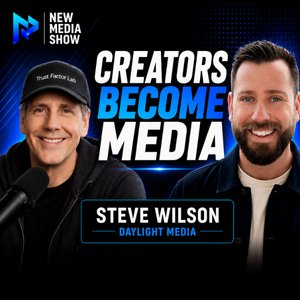
 In Episode #676 of the New Media Show, host and Podcast Hall of Famer Rob Greenlee welcomes Steve Wilson, Chief Strategy Officer at Daylight Media and QCODE, for a wide-ranging conversation about the shift from producing a successful podcast to building a sustainable creator-led media company.
Creators no longer operate in a simple world of publishing one show to ONE place and relying mainly on advertising.
The strongest creators are building direct relationships with audiences across podcasts, video, short-form clips, newsletters, communities, subscriptions, live events, products, and services.
Podcasting remains one of the most effective long-form formats for building trust and repeated audience connection.
It is now one part of a larger media strategy shaped by video distribution, platform algorithms, artificial intelligence, audience ownership, and the growing power of individual personalities.
Steve brings a valuable perspective to this discussion. Before joining QCODE, he spent years working with Apple Podcasts and iTunes. At QCODE, he helped develop and distribute premium scripted audio series featuring talent including Matthew McConaughey, Demi Moore, and Rami Malek. QCODE has since expanded through Daylight Media, which provides distribution, monetization, technology, marketing, and business support for a broader network of creators.
Daylight currently works with roughly 70 creators and shows representing approximately 300 million monthly audio downloads and video views.
Across that network, video now accounts for a significant share of consumption, although the balance between audio and video differs considerably from show to show.
That difference is important.
Some creators have audiences that strongly favor YouTube and Spotify video. Other shows continue to perform primarily through audio.
For some programs, video may be valuable mainly as a discovery and social marketing layer rather than as the central product. Steve argues that creators should evaluate their format, audience, resources, and business goals before committing to a major video expansion.
Rob and Steve discuss Apple’s HLS video support and why it may become an important addition to the podcast distribution ecosystem. HLS can give creators greater flexibility in delivering video while maintaining many of the ownership and control principles associated with RSS.
The larger issue is whether creators retain access to their audience data, revenue information, advertising options, and the ability to move their shows between services.
The conversation also examines what makes a show work in both audio and video.
A strong video presentation may include thoughtful set design, lighting, visual storytelling, archival material, graphics, and physical objects that add context. The underlying audio still needs to stand on its own.
Listeners should not feel as though they are receiving an incomplete version of a show because they cannot see what is happening on screen.
Steve points to television, documentary production, and the work of filmmakers such as Ken Burns as useful references.
A show can begin with excellent audio storytelling and add visuals that deepen the experience without making the audio audience feel secondary.
There are also cases where the audio and video products should remain different. Scripted fiction uses sound to create a theater of the mind, allowing listeners to imagine the world and its characters. Turning that same property into a visual production may require a separate creative and business decision rather than a simple video version of the podcast.
We also explore the potential for long-form content on Instagram, the renewed interest in vertical video, and the growing market for microdramas. They also revisit Quibi and consider whether some earlier media ideas failed because the technology, audience behavior, or distribution environment was not yet ready for them.
The discussion then turns to one of the most important distinctions between podcasting and YouTube.
YouTube can generate large spikes around individual videos, but performance may vary widely from episode to episode.
Traditional RSS-based podcast audiences are often more consistent. That stability can make an audio podcast especially valuable to advertisers because future episode delivery and revenue are easier to forecast.
YouTube is highly effective for discovery. Podcast feeds are often stronger at developing recurring habits around a series. Successful media companies will increasingly need to understand the value of both.
Catalog discovery is another major opportunity. Podcasts and long-form videos can remain useful for years, but most platforms continue to prioritize newly released material. Steve argues that the industry needs better ways to help audiences find relevant episodes from existing catalogs based on subject, location, interest, and current context.
Daylight recently acquired Podcast Review, a long-running editorial publication focused on podcast reviews, interviews, recommendations, and lists. Steve sees independent editorial guidance as an important part of helping audiences find strong shows beyond what algorithms automatically recommend. Podcast Review continues to publish consumer-focused coverage while operating as a Daylight Media property with stated editorial standards and disclosures.
Rob and Steve discuss whether the audience now has more influence over what qualifies as a podcast. Listeners and viewers increasingly use the word to describe a style of recurring, personality-led media rather than a specific technical delivery method.
Steve is less concerned with rigid format definitions. He compares the current debate to earlier questions about whether a streaming series released all at once should still be called television. Distribution formats change. Audience behavior changes. The most useful question is whether the content delivers the experience people expect from the show.
The second half of the episode focuses on creators becoming media companies.
Daylight works with creators at different stages, from established personalities such as Jon Stewart to growing shows entering advertising for the first time. Some partners need only ad sales support. Others are developing subscriptions, merchandise, tours, live events, networks, and additional shows.
Steve describes Daylight as an infrastructure layer that often works behind the scenes. The goal is to help the creator’s brand remain visible while providing the operational systems needed to grow. Daylight was launched as an expansion of QCODE’s creator-support work, with services covering distribution, audience development, marketing, technology, products, and monetization.
Creator-first structure differs from an older media model in which the studio or network brand often controlled the relationship between talent and audience. Steve believes the next era will give creators more leverage, flexibility, and ownership. The companies that support them will need to prove their value without taking over the show’s identity.
Artificial intelligence is already affecting that work, although adoption varies widely. Some creators are using AI for research, transcription, artwork, editing, and production support. Others remain strongly opposed to it.
Steve does not see the choice as a complete acceptance or rejection of AI.
Each use case needs to be evaluated separately. Voice dubbing may help a creator correct a short line without having to re-record an entire session. Transcription can reduce production time. Synthetic performances or undisclosed manipulation may violate the audience’s expectations and trust.
Both agree that growing volumes of synthetic content may also increase the value of live, in-person, and clearly human experiences.
Podcast tours, creator conferences, community gatherings, retreats, and interactive events allow audiences to participate in ways that digital platforms cannot fully reproduce. The opportunity may extend beyond recording a regular episode on stage.
Future creator events could include audience conversations, workshops, performances, shared activities, and experiences built around a particular community or interest.
This episode offers a clear view of where creator media is heading. A show can remain the center of the relationship, but the greater opportunity lies in building a flexible media business around the audience, protecting creator ownership, and selecting formats that serve the content rather than following every platform trend.
Topics Covered in This Episode
– Why successful creators are becoming media companies
– QCODE’s expansion into Daylight Media
– Audio and video consumption across the Daylight network
– Apple HLS video and creator-controlled distribution
– Why every show needs a different audio and video strategy
– Set design and visual storytelling for video shows
– Preserving a complete experience for audio listeners
– Scripted fiction, video adaptations, and intellectual property
– Instagram, vertical video, and microdramas
– YouTube discovery compared with RSS audience stability
– Evergreen content and podcast-catalog discovery
– Apple Podcasts editorial discovery
– Daylight Media’s acquisition of Podcast Review
– Whether audiences now define what a podcast is
– Revenue beyond advertising
– Subscriptions, merchandise, networks, touring, and events
– Daylight as a behind-the-scenes creator infrastructure company
– RSS, APIs, alternate enclosures, and platform control
– Creator access to audience and revenue data
– AI production tools and audience trust
– The growing value of live and human experiences
Chapter Time Stamp Markers:
00:00 Welcome to The New Media Show Episode 676
00:36 Creators are building full media businesses
02:24 Introducing Steve Wilson of Daylight Media and QCODE
03:05 How QCODE expanded into Daylight Media
04:23 From premium audio fiction to a creator network
05:16 Video now drives much of the network’s consumption
05:59 Apple HLS video and creator flexibility
08:27 Why there is no single audio-video strategy
09:03 What makes a show work in video?
10:44 Keeping audio listeners at the center
12:09 Higher production values and video set design
14:34 Theater of the mind and the value of audio
15:37 Short-form video and social-first podcasts
16:00 Could Instagram become a long-form video platform?
17:33 Microdramas, vertical storytelling, and the Quibi lesson
18:27 Audio-first creators and video anxiety
19:24 YouTube volatility compared with RSS stability
21:01 Tentpole episodes, long-form content, and audience habits
22:10 Evergreen catalog discovery
23:26 Apple Podcasts editorial discovery
25:00 Daylight Media acquires Podcast Review
25:46 Is the audience taking control of media definitions?
27:52 Does the technical definition of a podcast still matter?
31:03 Moving from a show to a media company
32:14 Daylight’s creator network and growth spectrum
32:54 Subscriptions, merchandise, tours, and new revenue
33:35 Daylight as a creator infrastructure layer
34:07 Why Daylight works behind the scenes
36:12 The future of video distribution and RSS
37:17 Alternate enclosures and location-based discovery
38:24 Creator ownership beyond RSS purity
39:59 Audio ads, video ads, platforms, and advertiser results
41:07 Independent creators gain more media power
42:07 How creators are using AI
43:02 Where AI can damage audience trust
45:05 AI voice dubbing and practical production uses
45:34 The return of live and human experiences
47:18 Podcast tours, conferences, and creator communities
49:18 Building more interactive creator events
50:51 Final thoughts on Daylight Media and QCODE
51:31 Where to find Daylight and QCODE shows
52:44 End of episode
Guest Links: Steve Wilson, Chief Strategy Officer, Daylight Media and QCODE
Daylight Media: https://daylightmedia.com
QCODE Media: https://qcodemedia.com
Podcast Review: https://podcastreview.org
Steve Wilson on LinkedIn: https://www.linkedin.com/in/stephenwilson7
Steve Wilson on Instagram: https://www.instagram.com/wilsonomics
Steve Wilson is currently Chief Strategy Officer at Daylight Media, with his work continuing across the QCODE and Daylight organizations.
Host, Rob Greenlee and New Media Show Links
New Media Show: https://newmediashow.com
New Media Show on YouTube: https://youtube.com/@TheNewMediaShow
New Media Show Audio on Apple Podcasts: https://podcasts.apple.com/us/podcast/new-media-show-audio/id392545649
Rob Greenlee Website: https://robgreenlee.com
Rob Greenlee on LinkedIn: https://www.linkedin.com/in/robgreenlee
Rob Greenlee on YouTube: https://youtube.com/@RobGreenlee
Podcast Hall of Fame: https://podcasthall.com
About Trust Factor Lab
Trust Factor Lab helps creators, media leaders, executives, and brands build stronger audience trust across AI, video, podcasts, and creator-led media. Founded by Rob Greenlee, it focuses on content strategy, authority development, media positioning, AI transparency, audience growth, and business outcomes built through credibility.
AI Disclosure Note:
I used AI tools to help organize and edit this episode description and create chapter markers from the episode transcript. The editorial direction, final review, industry perspective, and responsibility for the published content remain mine. The discussion reflects the views expressed by my guest and me during the recorded conversation.
Podcast: Play in new window | Download
Subscribe: Apple Podcasts | Android | Podcast Index | RSS
Podcast (audio): Play in new window | Download
Subscribe: Apple Podcasts | Spotify | Android | Podcast Index | RSS